


The Hard Law-Soft Law Nexus: Autonomous Vehicles as a Case Study
The technology governance debate often focuses on the dichotomy of hard law versus soft law as competing models. Both hard law and soft law have their strengths and weaknesses. But framing soft law versus hard law as a dichotomous choice is often unrealistic—every technology will be governed by a mix of hard law and soft law. So, the more realistic questions are where hard law works best and where soft law succeeds, and how these two types of governance interact and integrate. After reviewing the strengths and weaknesses of hard law and soft law, this Article identifies six different hybrid models integrating hard law and soft law. The article then considers hybrid hard law/soft law models in the context of autonomous vehicles (AVs) as a case study. After reviewing the challenges and stunted progress of AV regulation, the analysis focuses on two recent rulemakings in which the first Trump and then Biden administrations proposed frameworks for AV regulation in the waning days of their respective administrations. Analysis of the comments submitted by the broad range of AV stakeholders shows a sharply divided community, with about half of the stakeholders adamantly supporting a hard law approach, and another half equally favoring a soft law approach. However, there was substantial support for hybrid hard law/soft law models, with all six models identified earlier in the article and two new models receiving support. Based on this analysis, the Article suggests that a hybrid hard law/soft law approach is the most promising direction for AV governance.
Introduction
Hard law and soft law are often portrayed as two conflicting and competing models for technology governance.1Gary Marchant & Carlos Ignacio Gutierrez, Soft Law 2.0: An Agile and Effective Governance Approach for Artificial Intelligence, 24 Minn. J. L. Sci. Tech. 375, 390 (2023). Hard law consists of traditional legal instruments that encompass enforceable statutes, regulations and treaties. Soft law is defined as instruments that provide substantive expectations, but which are not directly enforceable by government.2Gary E. Marchant & Brad Allenby, Soft Law: New Tools for Governing Emerging Technologies, 73 Bull. Atomic Scientists 108, 108 (2017); Ryan Hagemann, Jennifer Huddleston & Adam D. Thierer, Soft Law for Hard Problems: The Governance of Emerging Technologies in an Uncertain Future, 17 Colo. Tech. L.J. 37, 47 (2018). Examples include codes of conduct, best practices, private standards, and public-private partnership programs. Both hard law and soft law have their respective strengths and weaknesses for governing emerging technologies.3See infra notes 7–50 and accompanying text.
Given the contrasting strengths and weaknesses, it should be no surprise that there are conflicting arguments on whether to use hard law or soft law to govern a particular technology or problem. But the question should not be whether to use hard law or soft law, but rather where and when to use each type of governance model. The reality is that every technology will be governed by some mix of hard law and soft law. It is analogous to the age-old debate on nature vs. nurture; we now know that the correct answer is that both nature and nurture affect every trait of a human or other living being.4Steven Pinker, Why Nature & Nurture Won’t Go Away, 133(4) Daedalus 5, 6 (2004) (“Nature and nurture, of course, are not alternatives.”). The proper focus is then to ask how nature and nurture interact, and how they each exercise their interdependent effects.5Id. at 7; see also Charles J. Kowalski & Adam J. Mrdjenovich, Beware Dichotomies, 59 Persp. Biol. & Med. 517, 517 (2016) (critiquing the tendency for “[t]he identification and naming of two distinct, opposing categories [that] often results in their being seen as in opposition to one another, and that it is somehow incumbent upon us to choose one or the other.”).
In the same way, a more sophisticated and nuanced approach to technology governance recognizes that both hard law and soft law have an essential role to play for every technology, and we need to focus on where and when each can be most useful, including how these two broad categories of governance interact across a technology and over time. That is the objective of this Article: to evaluate how hard law and soft law may interact, using autonomous vehicles (AVs) as a case study.
Part I defines and differentiates hard law and soft law governance, including describing their respective strengths and weaknesses. Part II then considers models and examples of how hard law and soft law may interact. Part III describes the challenges and status of governing autonomous vehicles in the United States, noting the complex mix of federal, state, and local regulation, as well as existing and proposed hard law and soft law measures. Part IV provides the results of an empirical analysis of various stakeholder positions and suggestions for autonomous vehicle governance in two recent requests for comments on a framework for governing AVs undertaken by the National Highway Transportation Safety Authority (NHTSA). Many of the stakeholders expressly or implicitly addressed in their comments in those two proceedings their perspectives on the relevant roles and, in some cases, the interaction of hard law and soft law for promoting AV safety. Drawing on that analysis, Part V concludes by proposing a hybrid hard law–soft law approach for governing AV safety.
I. Hard Law Versus Soft Law
Hard law and soft governance approaches have divergent underlying premises and assumptions, and very different strengths and weaknesses. It is therefore to be expected that they are often pitted against each other, with some policymakers and scholars preferring hard law approaches, and others advocating soft law approaches. In other words, the choice is often presented as binary of hard law versus soft law.
Traditional government regulation is hard law. Legislatures or government regulatory agencies at the federal or state level adopt binding rules that are enforceable against regulated entities. Most environmental, health and safety regulations over the past half-century have been in the form of hard law rules, enforceable by government agencies.6Susan E. Dudley & Jerry Brito, Regulation: A Primer 37 (2d ed., 2012) https://www.mercatus.org/research/books/regulation-primer (“In the context of regulatory rules, ‘traditional rulemaking’ tends to refer to the ‘informal rulemaking, or notice and comment rulemaking, is the most common process used by agencies for writing, or promulgating, regulations.” (quotations and citations omitted). Examples of hard law rules include national ambient air quality standards enforced upon states under the Clean Air Act by the Environmental Protection Agency (EPA),740 C.F.R. pt 50. occupational health and safety standards for toxic workplace exposures such as silica enforced against employers by the Occupational Safety and Health Administration (OSHA),829 C.F.R pt. 1926 Subpart D. and pharmaceutical approval requirements enforced against drug manufacturers by the Food and Drug Administration (FDA).921 C.F.R. pt. 314.
Hard law rules have a number of advantages, which explain why they have been the presumptive form of governance in many fields. Most importantly, because they are mandatory, regulators can take enforcement measures, including imposing civil or criminal penalties, if an entity fails to comply with a hard law regulation.10Diana M. Bowman & Graeme A. Hodge, ‘Governing’ Nanotechnology Without Government?, 35 Sci. & Pub. Pol’y 475, 484 (2008) (“[T]he ultimate consequences for rule breakers must be the power to enforce severe sanctions.”). This ensures that all regulated entities are required to comply with the rule, even though compliance is never complete.11Daniel A. Farber, Taking Slippage Seriously: Noncompliance and Creative Compliance in Environmental Law, 23 Harv. Envtl. L. Rev. 297, 304–05 (1999). The second key benefit of hard laws is that the existence of a government regulator that oversees compliance with the regulation provides confidence to the public that the underlying problem or risks are being addressed.12Alan McHughen, Fatal Flaws in Agbiotech Regulatory Policies, 25 Nat. Biotech. 725, 727 (2007) (“Good regulations serve two purposes: they must provide genuine protection from real hazards (primarily a scientific exercise) and they must also assuage public anxiety to instill confidence (primarily a political objective).”). This public confidence-generating function of government regulation is an important secondary benefit of hard law regulation.
However, hard law regulation also suffers from several limitations, the most important of which is the highly bureaucratic burden of adopting hard law rules.13Bowman & Hodge, supra note 10, at 477. For example, a major U.S. regulation adopted by a federal agency in the United States must not only provide extensive evidentiary support to justify the action, but must also run the gauntlet of conducting over 20 subsidiary analyses, each of which may seem sensible on its own, but which collectively massively burden and slow the pace of rulemaking.14Hagemann, Huddleston & Thierer, supra note 3, at 63–65, 104–06. The time taken to adopt a U.S. regulation has grown substantially over the past half century, especially when judicial review is involved (which it often is).15Gary E. Marchant, The Growing Gap Between Emerging Technologies and the Law, in The Growing Gap Between Emerging Technologies and Legal-Ethical Oversight: The Pacing Problem 19, 22–23 (Gary E. Marchant, et al., eds., 2011); World Economic Forum, Agile Regulation for the Fourth Industrial Revolution: A Tool Kit for Regulators 6 (Dec. 2020), https://www.weforum.org/about/agile-regulation-for-the-fourth-industrial-revolution-a-toolkit-for-regulators. So it has become increasingly difficult to adopt new regulations, and once a rule is in place, agencies generally lack the resources to amend and update their existing regulations on a timely basis. The combination of delays in both adopting and updating regulations results in a serious “pacing problem,” which is particularly problematic for fast-moving technologies like artificial intelligence.16Marchant, supra note 15, at 22–23; World Econ. Forum, supra note 15, at 6.
Hard law suffers from additional limitations, especially for rapidly developing emerging technologies. Regulatory agencies have limited jurisdiction, resources, staff, expertise and political will to adopt new regulations for an emerging technology such as artificial intelligence (AI).17William E. Kovacic & David A. Hyman, Regulating Big Tech: Lessons from the FTC’s Do Not Call Rule, 26 Va. J.L. & Tech. 1, 9 (2023); Bryan Naylor, Not Just Airplanes: Why the Government Often Lets Industry Regulate Itself, Nat’l Pub. Radio (Apr. 4, 2019, 5:01 AM), https://www.npr.org/2019/04/04/709431845/faa-is-not-alone-in-allowing-industry-to-self-regulate; Hagemann, et al., supra note 3, at 69; Daniel J. Fiorino, Voluntary Initiatives, Regulation, and Nanotechnology Oversight: Charting a Path 29 (2010), http://www.nanotechproject.tech/process/assets/files/8347/pen-19.pdf (“As for resources, it is fair to say that regulators always are struggling with constraints, especially on emerging issues where the regulatory infrastructure is lagging.”). Regulations must be supported by strong and extensive empirical evidence, which often does not exist for a new technology, especially one as diverse and heterogeneous as AI.18Edward J. Balleisen & Marc Eisner, The Promise and Pitfalls of Co-Regulation: How Governments Can Draw on Private Governance for Public Purpose, in New Perspectives on Regulation 127, 133 (David Moss & John Cisternino eds., 2009) (“Public regulators frequently confront daunting problems of information scarcity and complexity, even as they must cope with serious resource constraints.”). Proposed regulations are often second-guessed, watered down, or outright rejected by oversight from Congress, the Office of Information and Regulatory Affairs, or reviewing courts. Once the hard law rules are adopted, they often have poor compliance and enforcement, given scarce agency enforcement resources. Even so, hard law regulations can also block innovation by making it more expensive and burdensome for companies, especially small businesses, to create and advance new technological breakthroughs.19Andrea O’Sullivan & Adam Thierer, Regulators Should Allow the Greatest Space for AI Innovation, 51(12) Communications of the ACM 33 (2018). And the effect of hard law rules is limited to the legal jurisdiction in which they are promulgated.20 Stephen M. Maurer, Self-Governance in Science 180 (2017).
Fundamentally, hard law regulation is not the absolute fix of governance problems that it is often perceived to be. This “magic wand” perception of traditional government regulation assumes that if the government regulates a problem, the problem will be resolved completely. While properly targeted and limited government regulation can be an effective solution to a specific, well-defined problem, designing effective regulation is hard. There is a long and well-established list of problems with traditional regulation that often make regulation less effective than anticipated, or even in some cases counter-productive.21This list of problems with traditional regulation includes regulatory capture, entry barriers that favor incumbents, rent seeking, technology lock-in, slow adoption, failure to update, non-compliance, blocking innovation, over- or under-regulation, undue burdens and costs, regulatory gaps, and delegation issues. See generally Christine S. Wilson & Keith Klovers, The Growing Nostalgia for Past Regulatory Misadventures and the Risk of Repeating These Mistakes with Big Tech, 8 J. Antitrust Enf’t 10 (2020); George Stigler, The Theory of Economic Regulation, 2 Bell J. Econ. & Mgmt. Sci. 3, 5 (1971);. J. B. Ruhl & James Salzman, Mozart and the Red Queen: The Problem of Regulatory Accretion in the Administrative State, 91 Geo. L.J. 757, 792 (2003); Marchant & Gutierrez, supra note 2, at 380-84. For these reasons, Stephen Breyer, before being elevated to the U.S. Supreme Court, recommended that regulation be the “weapon of last resort,” used only when narrowly tailored to serious risks or societal problems.22 Stephen Breyer, Regulation and Its its Reform 184–85 (1982).
In contrast to enforceable hard law rules promulgated by regulatory agencies, soft law includes many different types of instruments, including private standards, codes of conduct, principles, guidelines, ethical codes, best practices, certification programs, voluntary programs, and private-public partnerships.23. Gary Marchant, Lucille Tournas & Carlos Ignacio Gutierrez, Governing Emerging Technologies Through Soft Law: Lessons for Artificial Intelligence—An Introduction, 61 Jurimetrics 1, 5 (2020). Soft law can be promulgated by a variety of different entities, including governmental bodies, but also industry groups, individual companies, non-governmental organizations, think tanks, professional societies, standard-setting bodies, certification agencies, or any combination of the above.24Kenneth W. Abbott, Gary E. Marchant, and Elizabeth A. Corley, Soft Law Oversight Mechanisms for Nanotechnology, 52 Jurimetrics 279, 298-99 (2012). Soft law addresses many of the limitations of hard law, which explains why soft law is increasingly used in many areas of governance.
A key benefit for fast-moving emerging technologies is that soft law measures can usually be enacted and revised much more quickly than hard law requirements.25. Id. at 301–02; Hagemann, Huddleston & Thierer, supra note 3, at 63–65, 104–06; Marchant, Tournas & Gutierrez, supra note 23, at 7. Soft law programs are not required to go through the gauntlet of bureaucratic and procedural hurdles that a hard law rule must comply with,26. See supra note 14 and accompanying text. and soft law measures are not subject to second-guessing by the courts and other administrative review requirements that often delay or sideline hard law rules.27See supra note 16 and accompanying text. For example, Underwriter Laboratories (UL) promulgated a private standard for AV safety in April 2020, and has already issued two updated standards in March 202228Philip Koopman, ANSI/UL 4600 Version 2 (2022), Safe Autonomy Blog (Mar. 15, 2022), https://safeautonomy.blogspot.com/2022/03/ul4600-version2.html and March 2023.29UL Standards & Engagement, UL 4600 Standard for Evaluation of Autonomous Products (2025), https://www.shopulstandards.com/ProductDetail.aspx?productId=UL4600_3_S_20230317. Given the potential for rapid enactment and revision, soft law is a critical part of recent proposals for more agile or adaptive governance.30 World Econ. F., supra note 15, at 17 (“Soft law can be more easily updated to keep pace with technological change . . . “); Org. for Econ. Coop. and Dev. [OECD], Recommendation of the Council for Agile Regulatory Governance to Harness Innovation, C/MIN(2021)23/FINAL 36 (Oct. 6, 2021), https://legalinstruments.oecd.org/en/instruments/OECD-LEGAL-0464 (“[S]elf- and co-regulation can be an important complement to a goal-based approach to regulation. Industry-led governance can be more accessible and less burdensome than regulation and ensure that actions to manage risks are designed and implemented by those who are best placed to do so.”).
Another important benefit of soft law is that it incorporates much broader expertise, resources, and perspectives in its enactment. While only government entities can enact hard law rules, any entity or group of entities can promulgate soft law measures.31 Fiorino, supra note 17, at 38. The government has limited supplies of expertise, experience, information, and resources, which can be improved by expanding the circle of entities that can enact soft law.32 World Econ. F., supra note 15, at 33 (“The information asymmetry between businesses and regulators means that industry is typically better placed to manage the risks from technological innovation in a way that is most efficient and effective.”); Maurer, supra note 20, at 179 (“Firms often possess uniquely valuable information about their internal operations, competitors’ activities, and the economic and technological feasibility of standards. NGOs may similarly know more about social needs and the private sector’s conduct on the ground.”). For example, with the AV case study that is the focus of the last half of this Article, the government generally lacks the expertise and first-hand knowledge needed to effectively regulate this complex and diverse industry.33Tracy Hresko Pearl, Is an Autonomous Vehicle a Roller Coaster or a Hollywood Film?, 50 BYU L. Rev. 431, 473 (2024).
Other organizational aspects of soft law confer additional advantages. Hard law regulation is typically an adversarial process, in which government agencies unilaterally enact rules that they then enforce against regulated parties. In contrast, soft law is a voluntary system in which entities voluntarily agree to comply and cooperate.34Hagemann, Huddleston & Thierer, supra note 3, at 50–51; Wendell Wallach & Gary Marchant, Toward the Agile and Comprehensive International Governance of AI and Robotics, 107 Proc. IEEE 505, 506 (2019); Fiorino, supra note 17, at 25; Marchant, Tournas & Gutierrez, supra note 23, at 8. Soft law is often generated through multi-stakeholder processes that include a variety of interests and perspectives, including those of industry and their civil society critics, helping to create a healthier ethos emphasizing cooperation and understanding. In addition, unlike hard law regulation in which one agency has the authority to adopt a single rule for a specific problem, a multitude of entities can put forward soft law proposals for the same problem, allowing a “1000 flowers to bloom,” and creating a competitive marketplace for the best soft law approaches.35Gary Marchant, “Soft Law” Governance of Artificial Intelligence, AI Pulse 4 (Jan. 25, 2019) [hereinafter Marchant, AI Soft Law], https://escholarship.org/uc/item/0jq252ks; Marchant, Tournas & Gutierrez, supra note 23, at 8; Janna Anderson & Lee Rainie, As AI Spreads, Experts Predict the Best and Worst Changes in Digital Life by 2035, Pew Research Ctr. (June 21, 2023), https://www.pewresearch.org/internet/2023/06/21/as-ai-spreads-experts-predict-the-best-and-worst-changes-in-digital-life-by-2035 [perma.cc/852B-J8ZG] (reporting that many experts believe that AI tools such as ChatGPT will start with a “‘let-a-thousand-flowers-bloom’ strategy for a few years.”).
Yet another category of benefits for soft law measures is that they are not subject to many of the restrictions that limit the effectiveness of hard law rules promulgated by federal agencies. Government agencies can only exercise the authority they have been delegated, which often omits some problems altogether, or limits the agency to only considering certain factors but not others when making regulatory decisions.36Gary Marchant, Ann Meyer & Megan Scanlon, Integrating Social and Ethical Concerns Into Regulatory Decision-Making for Emerging Technologies, 11 Minn. J. L. Sci. & Tech. 345–363 (2010) (government regulators often precluded from considering ethical aspects of technologies). Hard law regulators are further limited by recent Supreme Court decisions preventing agencies from regulating “major questions” that have not been delegated by Congress,37West Virginia v. EPA, 597 U.S. 97 (2022). and overturning the long-standing deference that courts have given to agency interpretations of ambiguous statutes.38Loper Bright Enterprises v. Raimondo, 603 U.S. 369 (2024). See Walter G. Johnson & Lucille M. Tournas, The Major Question Doctrine and the Threat to Regulating Emerging Technologies, 39 Santa Clara High Tech. L.J. 137 (2022); Blair Levin & Tom Wheeler, The Supreme Court’s Major Question Doctrine and AI Regulation, Brookings (Sep. 6, 2023), https://www.brookings.edu/articles/the-supreme-courts-major-questions-doctrine-and-ai-regulation. In contrast, soft law has plenary authority, and can address any problem or consider any factor its proponents choose.39Marchant, Tournas & Gutierrez, supra note 23, at 7-8; Hagemann, Huddleston & Thierer et al., supra note 3, at 98. In addition, hard law rules are limited in their effect to the legal jurisdiction of the promulgating government agency. Soft law again has no such limitations, and can automatically apply across jurisdictions, making it particularly well-suited for international governance.40 World Econ. F., supra note 15, at 36 (“[S]elf and co-regulation can support a more joined-up approach to regulation across regions and nations by embedding common rules across jurisdictions.”); Abbott, Marchant & Corley, supra note 24, at 302; Marchant, Tournas & Gutierrez, supra note 23, at 8.
Of course, soft law has its own limitations and challenges as well. The biggest weakness of soft law is that compliance is voluntary, so there is no assurance that all relevant entities will accept conformance, and even some of those who do may comply only partially or half-heartedly, given the lack of any direct enforcement.41Marchant, AI Soft Law, supra note 35, at 4; Fiorino, Voluntary Initiative, supra note 17, at 39; Marchant & Gutierrez, supra note 2, at 386; Abbott, Marchant & Corley, supra note 24, at 302–03; Marchant, Tournas & Gutierrez, supra note 23, at 9. There are a number of mechanisms that can provide indirect enforcement of soft law measures, such as pressure from consumer groups, trade associations, supply chain partners, insurers, liability lawyers, and the Federal Trade Commission.42. Marchant & Gutierrez, supra note 2, at 402–24 (describing 13 tools for indirect enforcement of soft law commitments). Nonetheless, the lack of direct enforcement mechanisms is the major limitation of soft law that adversely affects accountability. Companies can engage in “ethics washing” by purporting to adopt and follow soft law principles but in reality, are using that soft law mechanism as cover to engage in an unethical or irresponsible manner.43Karen Hao, In 2020, Let’s Stop AI Ethics-Washing and Actually Do Something, Tech. Rev. (Dec. 27, 2019), https://www.technologyreview.com/2019/12/27/57/ai-ethics-washing-time-to-act; Marchant, Tournas & Gutierrez, supra note 23, at 9; see also Balleisen & Esiner, supra note 18, at 132.
Related to the lack of direct enforcement, soft law measures are generally less trusted by the public than hard law.44Libby Maman, et al., Varieties of Regulatory Regimes and Their Effect on Citizens’ Trust in Firms, 30 J. Eur. Pub. Pol’y 2807, 2807 (2023) (empirical study finding that “citizens’ trust increases with the existence of a state regulator and decreases with self-regulatory regimes and deregulation”); see also Gary E. Marchant & Kenneth W. Abbott, International Harmonization of Nanotechnology Governance Through “Soft Law” Approaches, 9 Nanotechnology L. & Bus. 393, 398–99 (2013); Marchant & Allenby, supra note 3, at 4; Marchant, Tournas & Gutierrez, supra note 23, at 9. Knowledge that a government agency has enacted the rules and stands ready to enforce them is perceived by the public as an independent and objective check on the relevant technology or industry.45See McHughen, supra note 12, at 727. This role of creating public confidence is often seen as a secondary or indirect benefit of regulation, over and above the primary role in controlling potentially dangerous conduct or products. In contrast, soft law measures are often seen as the fox guarding the henhouse, as the very companies that might be involved in creating and selling the technology at issue often play a significant role in creating and implementing soft law programs.46Soft law is often perceived as synonymous with self-regulation, but self-regulation is only one type of soft law. Most soft law programs include entities external to the industry being governed. For example, a recent analysis of over 600 soft law programs for AI found that government, acting in a non-regulatory role, was the leading participant in these AI soft law programs, not industry. Carlos I. Gutierrez & Gary Marchant, A Global Perspective of Soft Law Programs for the Governance of Artificial Intelligence, SSRN (May 28, 2021), https://ssrn.com/abstract=3855171. This public distrust in self-regulatory measures has been exacerbated by a “techlash” caused by recent corporate wrongdoings by companies such as Facebook, Boeing, Theranos, and Volkswagen.47Darrell M. West, Techlash Continues to Batter Technology Sector, Brookings (Apr. 2, 2021), https://www.brookings.edu/blog/techtank/2021/04/02/techlash-continues-to-batter-technology-sector; Marchant & Gutierrez, supra note 2, at 377.
Although lack of accountability and public confidence are the two most important weaknesses of soft law, there are other limitations as well. While soft law expands the scope of entities that can create governance mechanisms beyond government regulators, they do not provide the same right as government regulation for any stakeholder to submit comments that might influence the content of the resulting rule. Soft law programs are often developed behind closed doors, with only certain pre-selected organizations or individuals at the negotiation table. Even after enactment, many soft law programs have limited transparency about how and by whom they are implemented.48Marchant & Abbott, supra note 44, at 398; Marchant, Tournas & Gutierrez, supra note 23, at 9.
Soft law measures are also often written in very general and broad terms, which makes holding entities accountable for conformance with such measures difficult and subjective.49William S. Laufer, Social Accountability and Corporate Greenwashing, 43 J. Bus. Ethics 253 (2003). Finally, the flip side of the soft law benefit of “letting a 1000 flowers bloom” is that the ecosystem can be flooded with dozens or more competing soft law programs for a particular technology or risk.50 Maurer, Self-Governance, supra note 20, at 42–43 (describing “standards war” beyond competing soft law initiatives on DNA synthesis safeguards). Entities must therefore choose which subset of soft law programs to adopt, which can create controversy and confusion.
II. Hard Law and Soft Law
The previous section identified key strengths and weaknesses of hard law versus soft law. Based on those factors, some problems are best addressed by hard law, while others are best left for soft law. For example, a discrete and narrowly defined technology, which is causing known harm to human health or safety, should preferentially be regulated by hard law, assuming an existing agency has regulatory jurisdiction over that risk. On the other hand, a broad and rapidly evolving technology, with uncertain benefits, risks and trajectories, is best suited for soft law, at least in the short term.
The question of whether hard law or soft should govern is thus often overly simplistic. Most technologies should and will be governed by some mix of hard law and soft law.51Philip J. Weiser, Entrepreneurial Administration, 97 Boston U. L. Rev. 2011, 2012 (2017) (“[E]ffective administration depends on entrepreneurial leadership that can spearhead policy experimentation and trial-and-error problem-solving, including the development of regulatory programs that use non-traditional tools.”). .Hence, the appropriate inquiry is what are the appropriate roles for hard law and soft law in governing a particular technology, and how should this change across problems and applications, and over time. There is growing recognition that both hard law and soft law have their appropriate roles to play.52Marchant & Gutierrez, supra note 2, at 390-91; OECD, supra note 30, at 14 (setting forth roles for hard law and soft law in a program for agile governance). Bowman and Hodge distinguish a third category of governance called “hybrid” governance that combines both hard law and soft law, distinguishing it from “state regulation” (i.e., hard law) and “civil regulation” (i.e., soft law).53Bowman & Hodge, supra note 10, at 477, 478–79 (“[T]hese three broad regulatory thrusts (state, civil, and hybrid regulation) should not be thought of as being mutually exclusive, but rather existing along a continuum.”). There are several different models of how hard law and soft law can interact,54Id., at 478 (“Hybrid regulation may encompass various forms of co-regulation, enforced self-regulation, meta-regulation, and multi-level regulatory instruments, and can be viewed as the coming together of public and private actors, albeit to varying degrees.”). with examples provided below.
A. Government Convenes, Rewards or Orchestrates Soft Law
Many soft law programs are created, coordinated, or rewarded by government entities, which have the potential to enact hard law rules, but choose instead to use soft law approaches in specific contexts. In many cases, the governmental entity conceives, designs, and administers the soft law program on its own. A well-known example is the Energy Star Program administered by the U.S. Environmental Protection Agency (EPA).55About, Energy Star, https://www.energystar.gov/about (last accessed Apr. 4, 2026). EPA describes this project as a “public-private partnership” because thousands of private companies voluntarily choose to participate in the program.56Id. The Energy Star program was initially adopted by EPA on its own initiative but was later codified as a “voluntary program” by Congress in 2005. Energy Policy & Conservation Act, 42 U.S.C. § 6294a (2005). Energy Star is a voluntary labeling program in which EPA sets energy efficiency specifications for specific types of appliances or equipment, and then private companies that meet those specifications can label their products with the Energy Star logo.57How Energy Star Works, Energy Star, https://www.energystar.gov/about/how-energy-star-works (last accessed Apr. 4, 2026). Many businesses, contractors, and consumers specifically look for Energy Star products, and various types of incentives, such as utility rebates for purchase of Energy Star products, encourage the purchase of Energy Star labeled products.58Souvik Datta & Massimo Filippin, Analyzing the Impact of ENERGY STAR Rebate Policies in the US, 9 Energy Efficiency 677, 678 (2016). In May 2025, it was reported that the EPA plants to shut down the Energy Star program as part of an initiative to defund climate programs that are not required by statute.59Lisa Friedman & Rebecca F. Elliott, E.P.A. Plans to Shut Down the Energy Star Program, N.Y. Times (May 6, 2025), https://www.nytimes.com/2025/05/06/climate/epa-energy-star-eliminated.html.
Government entities can also incentivize private actors to take voluntary actions by rewarding them with some benefit, such as public recognition or reduced enforcement scrutiny.60 World Econ. F., supra note 15, at 34 (“For self-regulation initiatives, regulators may incentivize compliance by reducing the regulatory burden for businesses that choose to participate in the scheme (‘earned recognition’). Benefits may include reduced reporting or inspection requirements.”). For example, EPA’s National Environmental Performance Track program, which ran from 2000 to 2009, identified and rewarded companies that go “above and beyond” environmental compliance to achieve superior environmental performance.61National Environmental Performance Track, EPA, https://archive.epa.gov/performancetrack/web/html/index.html (last accessed Apr. 4, 2026). Companies that achieved benchmarks of superior environmental performance received lower priority for routine inspections and were offered public recognition, networking opportunities, and other benefits.62Id. EPA claimed that this program achieved substantial environmental benefits that could not have been achieved with traditional environmental regulation,63EPA, Performance Track Final Progress Report 1 (May 2009), https://archive.epa.gov/performancetrack/web/pdf/pt_progrprt_2009_web.pdf. although a subsequent independent empirical assessment found no net benefits from the program due to business reluctance to make meaningful changes in return for the limited benefits offered by the voluntary program.64Cary Coglianese & Jennifer Nash, Performance Track’s Postmortem: Lessons from the Rise and Fall of EPA’s “Flagship” Voluntary Program, 38 Harv. Envtl. L. Rev. 1, 80 (2014) (“Even when the program offered rewards that included relief from the kind of regulatory requirements that many businesses often complain about, businesses were simply not interested in jumping through the agency’s hoops to receive the promised relief.”).
Government entities can also orchestrate soft law programs by using their influence to convene the relevant stakeholders, but then leaving it to industry and other stakeholders to design and implement the program.65 Maurer, Self-Governance, supra note 20, at 184–85. For example, the National Telecommunications & Information Administration (NTIA) within the Department of Commerce has convened a number of multi-stakeholder processes to negotiate a consensus approach to emerging technologies such as unmanned aircraft systems (or drones).66NTIA, Multistakeholder Process: Unmanned Aircraft Systems (June 21, 2016), https://www.ntia.gov/other-publication/multistakeholder-process-unmanned-aircraft-systems. In the case of drones, this process resulted in a voluntary best practices document for drone privacy and governance.67Voluntary Best Practices for UAS Privacy, Transparency, and Accountability–Consensus, Stakeholder-Drafted Best Practices Created in the NTIA-Convened Multistakeholder Process (May 18, 2016), https://www.ntia.gov/files/ntia/publications/uas_privacy_best_practices_6-21-16.pdf.
Experimental legislation represents another approach where governments utilize soft law mechanisms to test and refine regulatory approaches. These temporary legal measures allow for the testing of new policies or legal solutions within limited geographic areas or subjects.68Sofia Ranchordas, Experimental Regulations and Regulatory Sandboxes: Law without Order?, (University of Groningen Faculty of Law Research Paper No. 10/2021, Sep. 30, 2021), https://ssrn.com/abstract=3934075, at *5-6. Regulatory sandboxes have emerged as a specific form of experimental legislation, particularly in the context of technological innovation.69Chang-Hsien Tsai, et al., The Diffusion of the Sandbox Approach to Disruptive Innovation and Its Limitations, 53 Cornell Int. L.J. 261 (2020); Walter G. Johnson, Caught in Quicksand? Compliance and Legitimacy Challenges in Using Regulatory Sandboxes to Manage Emerging Technologies, 17 Regulation & Governance 709 (2023). These controlled regulatory environments allow for the testing of novel products or processes under the supervision of regulatory authorities.70Deirdre M. Ahern, Regulators Nurturing FinTech Innovation: Global Evolution of the Regulatory Sandbox as Opportunity Based Regulation (European Banking Institute Working Paper Series no. 60, Mar. 9, 2020), https://ssrn.com/abstract=3552015, at *108–09. Sandboxes typically involve temporary regulatory relief or customized compliance assistance for a select group of participants, enabling closer collaboration between regulators and innovators. This approach aims to reduce regulatory burdens, promote innovation, and help regulators better understand emerging technologies and business models.
The first regulatory sandbox was created by the United Kingdom government in 2015 for fintech applications.71Fin. Conduct Auth., Regulatory Sandbox ¶ 2.2 (Nov. 2015),
https://www.fca.org.uk/publication/research/regulatory-sandbox.pdf. Since then, the regulatory sandbox concept has spread to many other jurisdictions and technologies.72Cristie Ford & Quinn Ashkenazy, The Legal Innovation Sandbox, 72 Am. J. Comp. Law 557, 558-59 (2024). Most recently, the regulatory sandbox model has been applied to AI governance.73OECD, Regulatory Sandboxes in Artificial Intelligence (OECD Digital Economy Papers No. 356, July 2023), https://www.oecd.org/content/dam/oecd/en/publications/reports/2023/07/regulatory-sandboxes-in-artificial-intelligence_a44aae4f/8f80a0e6-en.pdf. The EU AI Act requires each Member State to have at least one operational AI sandbox in place by August 2026 (although nations may share cross-border sandboxes).74EU, The Artificial Intelligence Act, O.J. (L. 2024/1689) ¶ 138. In the U.S., President Trump’s July 2025 “America’s AI Action Plan” calls on U.S. federal agencies to establish AI regulatory sandboxes around the country, “where researchers, startups, and established enterprises can rapidly deploy and test AI tools.”75Office of the President, Winning the Race: America’s AI Action Plan, White House 5 (July 2025), https://www.whitehouse.gov/wp-content/uploads/2025/07/Americas-AI-Action-Plan.pdf.
These examples illustrate how governments are increasingly convening or creating soft law approaches like voluntary programs or regulatory sandboxes to navigate the complex landscape of technological innovation and regulation. By orchestrating these controlled environments outside of traditional regulatory approaches, governments can foster collaboration between regulators and innovators, gather valuable insights, and potentially develop more effective and innovation-friendly regulatory frameworks.76Ranchordas, supra note 68, at 129-30. The role of governmental entities in convening, incentivizing, or orchestrating soft law programs is a major contributor to soft law programs, and is also a significant evolution for governmental entities from their traditional hard law role to becoming a key player in soft law.
B. Hard Law “Backstops” Soft Law
The government can create incentives for private entities to develop and conform to a soft law program by threatening to implement a hard law program if companies do not adopt a suitable soft law program on their own.77Balleisen & Esiner, supra note 18, at 137. An example is the Health and Safety Partnership Program (“HSPP”) implemented by the North American Insulation Manufacturers Association (NAIMA) in response to a “Priority Planning Process” document published by OSHA.78See Gary E. Marchant & Angus Crane, The Benefits and Challenges of a Voluntary Occupational Exposure Database, 53 J. Occup. Envtl. Med. S52, S52-S53 (2011). In that document, OSHA identified 18 priorities for regulatory action, including synthetic vitreous fiber products such as fiberglass insulation, but invited industries to come forward with a voluntary alternative to regulatory action.79Id. NAIMA then negotiated the HSPP with OSHA to start in 1999, and has now been implementing this voluntary program as an alternative to hard law regulation for 25 years, achieving far more safety benefits than an OSHA rule could have accomplished.80Id. at S53.
A related approach is when a government agency puts forth an actual or hypothetical hard law program as a regulatory “back stop” to induce greater participation in the voluntary program.81 World Econ. F, supra note 15, at 33. In other words, if the private industry fails to adequately implement the voluntary program, the government will step in with a hard law program that presumably would be more burdensome for industry, thus creating an incentive to conform to the voluntary program. An example of such a strategy was the repeated discussion of regulatory backstops in the negotiation and final text of the voluntary National Low Emission Vehicle (NLEV) program at the turn of the last century. The NLEV program was a voluntary program in which vehicle manufacturers agreed to comply with a stricter but uniform national emission standard that EPA was statutorily precluded from adopting and enforcing as a hard regulation, in exchange for eliminating the different state-by-state patchwork of emission standards that was developing.82EPA, Control of Air Pollution From New Motor Vehicles and New Motor Vehicle Engines: Voluntary Standards for Light-Duty Vehicles, 62 Fed. Reg. 31192 (June 6, 1997). An important part of the negotiation, and a key point of leverage over the vehicle manufacturers, was that if manufacturers failed to comply with the NLEV standards, states that had previously adopted the California Low Emission Vehicle (CAL LEV) standards could immediately reinstate those programs as a ‘backstop” to encourage compliance.83Id. at 31226 (“Because manufacturers would have to comply with backstop CAL LEV programs in one or more States upon an opt-out, manufacturers will be reluctant to destabilize National LEV.”).
In the realm of standard-essential patents (SEPs) and technology standards, antitrust law enforced by the Federal Trade Commission (FTC) serves as a hard law backstop to the soft law mechanisms of industry self-regulation through Standard-Setting Organizations (SSOs) and Fair, Reasonable, and Non-Discriminatory (FRAND) commitments. SSOs often require participants to disclose relevant patents and commit to licensing their SEPs on FRAND terms as safeguards against potential anticompetitive behavior.84John E. Dubiansky Competition, Intellectual Property Rights and Collaboratively Set Standards: Federal Trade Commission Advocacy and Enforcement, in Complications and Quandaries in the ICT Sector 99, 100 (Ashish Bharadwaj, et al., 2018) However, when these soft law mechanisms fail to prevent anticompetitive conduct, the FTC can step in with antitrust enforcement actions.
The FTC has brought cases challenging deceptive conduct and failure to abide by FRAND licensing obligations.85Rebecca Kelly Slaughter, Comm’r FTC, SEPs, Antitrust, and the FTC (Oct. 29, 2021), https://www.ftc.gov/system/files/documents/public_statements/1598103/commissioner_slaughter_ansi_102921_final_to_pdf.pdf [hereinafter Slaughter, Remarks] For instance, in the Dell case, the FTC alleged that Dell’s failure to voluntarily disclose a relevant patent during a standard-setting process violated Section 5 of the FTC Act.86Joseph Kattan, Disclosures and Commitments to Standard-Setting Organizations, 16 Antitrust 22, 25 (2002). This demonstrates how antitrust law can serve as a backstop when SSO disclosure policies are insufficient or not followed. Similarly, the FTC has acted against SEP holders who seek exclusionary remedies against willing licensees, viewing such conduct as potentially violating FRAND commitments and harming competition.87See Slaughter, Remarks, supra note 85.
This approach creates an incentive for industry participants to adhere to SSO policies and FRAND commitments, as failure to do so could result in more burdensome antitrust enforcement actions. The FTC’s enforcement actions serve as a “backstop to monitor and enforce against conduct in the standard-setting context that harms competition.”88Id. The threat of antitrust intervention thus reinforces the effectiveness of the soft law mechanisms in the standard-setting context, much like the regulatory backstops in the NLEV program encouraged compliance with the voluntary emissions standards.
A final example of the threat of hard law backstopping soft programs is the Motion Picture Association of America (MPAA) movie rating system.89Pearl, supra note 33, at 457-69. The MPAA adopted this voluntary movie rating scheme in order to head off plans by the federal government to regulate movie content.90Id. at 463-64. The success of this soft law program “has kept the government off the back of the film industry.”91Id. at 468-69. See also Claire Piepenburg, Not Yet Rated: Self-Regulation and Censorship Issues in the U.S. Film Industry, 25 UCLA Ent. L. Rev. 97, 128 (2018) (“Since the creation of the MPAA, the looming threat of government intervention has been, if not the most, then one of the most effective ways of encouraging self-regulation within the motion picture industry.”).
C. Soft Law Evolves into Hard Law
Another potential relationship between soft law and hard law is a temporal one, in which soft law evolves into hard law. It may be that the technology and governance issues for a particular issue are too uncertain and unsettled for enacting a hard law solution initially. In these situations, soft law can provide an initial governance framework, which may be just an interim solution. The soft law experience can generate information on what works and what does not to better inform the subsequent hard law enactment. Providing a pathway for growing a soft law program into a future hard law program is one way for a soft law program to succeed,92 Fiorino, Voluntary Initiative, supra note 17, at 38 (a feature of soft law programs is “(1) to inform and prepare the ground for regulation or (2) to complement existing and future regulatory capacities rather than to supplant them.”). although not all soft law programs need or should evolve into hard law.
The evolutionary trajectory of soft law to hard law is shown below in Figure 1.
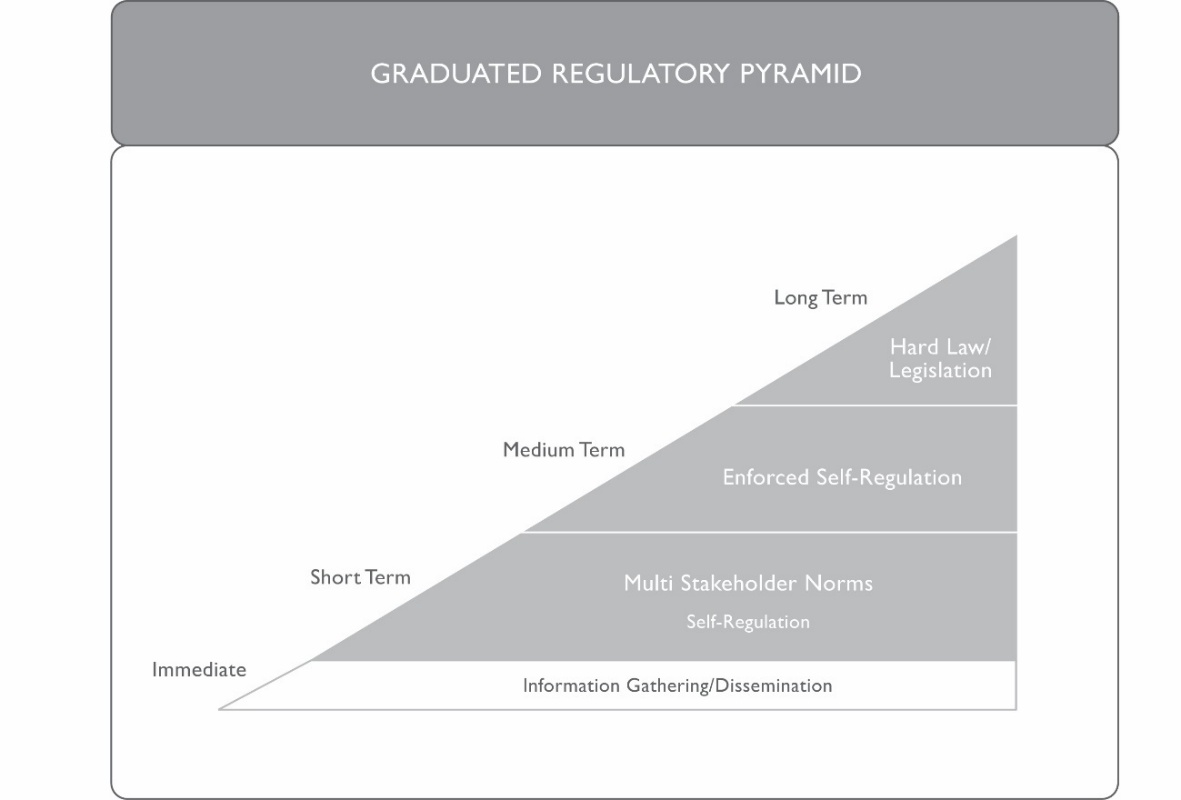
Figure 1: Evolutionary trajectory of soft law to hard law.93Gary E. Marchant, Douglas S. Sylvester & Kenneth W. Abbott, Risk Management Principles for Nanotechnology, 2 Nanoethics 43,54 (2008).
An example of this soft law to hard law transition is the regulation of fuel economy savings from improvements to the trailers of heavy-duty vehicles. The Energy Independence and Security Act of 2007 required EPA and NHTSA to adopt standards to regulate carbon emissions and fuel economy for medium- and heavy-duty commercial vehicles.94Energy Independence and Security Act of 2007, Pub. L. 110-140, 110th Cong. § 202(b) (2007), codified at 49 U.S.C. § 32902(k). The first such federal regulations were adopted in 2011 and focused on more efficient engines for such vehicles. The agencies considered but did not adopt standards for the trailers for such vehicles, explaining:
Neither EPA nor NHTSA is adopting standards at this time for GHG emissions or fuel consumption, respectively, for heavy-duty commercial trailers . . . The agencies recognize that aerodynamic and tire rolling resistance improvements to trailers represent a significant opportunity to reduce fuel consumption and GHGs as evidenced, among other things, by the work of the EPA SmartWay program.95EPA & NHTSA, Greenhouse Gas Emissions Standards and Fuel Efficiency Standards for Medium- and Heavy-Duty Engines and Vehicles, 76 Fed. Reg. 57106, 57111 (Sept. 15, 2011).
The agencies were uncertain which technologies or improvements would improve the fuel economy of trailers, nor did they have good data to quantify any carbon reduction and fuel economy improvements from such interventions. So, as indicated in the quote above, the agencies relied on a voluntary program called “SmartWay” to test different approaches for improving the fuel economy of heavy-duty trailers.
SmartWay is a voluntary public-private program created in 2004 by EPA in partnership with the transportation industry to promote more sustainable transport,96Learn About SmartWay, EPA https://www.epa.gov/smartway/learn-about-smartway (last accessed Apr. 3, 2026). and now has almost 4000 company partners.97SmartWay Program Successes, EPA, https://www.epa.gov/smartway/smartway-program-successes (last accessed Apr. 3, 2026). The SmartWay program tested and quantified fuel economy savings from various aerodynamic devices on the trailer such as improved tires, skirts and rear fairings.98SmartWay Verified List of Aerodynamic Devices, EPA, https://www.epa.gov/verified-diesel-tech/smartway-verified-list-aerodynamic-devices (last accessed Apr. 3, 2026). This test program confirmed which equipment improved fuel economy and by how much, but also reassured drivers who had concerns about the convenience and safety of some such devices.99For example, some drivers were concerned that the skirts under the trailer would get stuck on curbs or other surface irregularities encountered during loading and unloading operations. The findings from the voluntary SmartWay program demonstrating successful aerodynamic interventions lead the state of California to then adopt trailer fuel economy requirements expressly based on the SmartWay certifications in its hard law regulations.100The California medium- and heavy-duty greenhouse emissions standards adopted in 2008 provided that: “As of 1 January 2010, no 2011 or subsequent model-year 53 ft. or longer dry-van trailer is allowed to travel on a highway within California unless such a trailer is either a U.S. EPA SmartWay Certified Trailer, or is equipped with both of the following: (1) tires that are U.S. EPA SmartWay Verified Technologies and (2) trailer aerodynamic technology-or combination of technologies as outlined in the regulation.” California Air Resources Board, Final Regulation Order to Reduce Greenhouse Gas Emissions from Heavy-Duty Vehicles 10 (2011), https://ww2.arb.ca.gov/sites/default/files/barcu/regact/2008/ghghdv08/ghgfro.pdf. Once the California hard law regulations validated the benefits from the SmartWay program, the EPA and NHTSA subsequently adopted similar requirements (again based on the SmartWay verified technologies) into the second generation of federal heavy-duty vehicle greenhouse gas and fuel economy regulations.101In perhaps a fitting demonstration of the difficulties of hard law regulation, these federal trailer standards were subsequently overturned by a court as beyond the regulatory authority of EPA and NHTSA. Truck Trailer Manufacturers Ass’n v. EPA, 117 F.4th 1198 (D.C. Cir. 2021). So here we have an example of regulating a new technology starting with soft law, progressing then to state hard law, and finally to federal hard law, with each enactment building on the findings of the previous program.
There are other examples of soft law programs evolving into hard law regulations. For example, the National Institute of Standards and Technology (NIST) Cybersecurity Framework represents an evolving example of soft law transitioning towards hard law in the cybersecurity domain.102See Emile Loza de Siles, Soft Law for Unbiased and Nondiscriminatory Artificial Intelligence, 40 IEEE Tech. & Soc’y Mag. 77, 78–79 (2021) (describing how NIST cybersecurity framework evolved from soft law to hard law). See also Maurer, Self-Governance, supra note __, at 180 (supporting the notion that NIST cybersecurity framework evolved from soft to hard law). Initially developed as a voluntary guideline in response to Executive Order 13636,103National Institute of Standards and Technology, Framework for Improving Critical Infrastructure Cybersecurity v (Apr. 16, 2018), https://nvlpubs.nist.gov/nistpubs/cswp/nist.cswp.04162018.pdf. the Framework provided a flexible, risk-based approach to managing cybersecurity risk.104Id. at 1. This soft law approach allowed organizations to adapt the framework to their specific needs and risk tolerances. The Framework’s transition towards hard law began with the Cybersecurity Enhancement Act of 2014. This legislation codified NIST’s role in developing cybersecurity frameworks, giving legislative backing to what was previously a voluntary initiative.105Cybersecurity Enhancement Act of 2014 § 101, 15 U.S.C. § 7421. The Act required NIST to “identify and develop cybersecurity risk frameworks for voluntary use by critical infrastructure owners and operators.”106Id. While still emphasizing voluntary adoption, this legislative mandate represented a significant step towards formalizing the Framework’s status.
Furthermore, the Act required federal agencies to coordinate with NIST in developing standards and guidelines,107Id. at § 201. effectively integrating the Framework’s principles into government cybersecurity policies. This legislative recognition elevated the Framework’s status from purely voluntary guidance to a Congressionally mandated approach for improving cybersecurity across critical infrastructure sectors.
The Framework continues to evolve, with NIST releasing updated versions based on stakeholder feedback and changing cybersecurity landscapes.108NIST, supra note 103, at VI. This ongoing development, coupled with its legislative backing, illustrates how the Framework serves as a dynamic bridge between soft law flexibility and hard law authority in the rapidly changing field of cybersecurity.
Another example of soft law evolving into hard law is greenhouse gas emissions reporting requirements. Initially, many companies voluntarily disclosed their greenhouse gas emissions through initiatives such as the Carbon Disclosure Project (CDP), a soft law approach that began in 2003.109CDP’s Alignment with Disclosure Frameworks and Standards, Carbon Disclosure Project, https://www.cdp.net/en/about/framework-alignment (last accessed Apr. 3, 2026). This voluntary reporting regime allowed companies and regulators to gain experience with emissions reporting practices without the constraints of hard law, which then opened the door to mandatory hard law greenhouse gas emissions reporting requirements.
The United Kingdom provides a clear illustration of this evolutionary trajectory. Prior to 2013, approximately 50% of UK-incorporated listed companies were already voluntarily disclosing greenhouse gas emissions.110Jody Grewal, The Effects of Transparency Regulation on Voluntary Disclosers: Evidence from Mandatory Carbon Reporting (2017), https://corporate-sustainability.org/wp-content/uploads/Grewal_Effects_of_Transparency-Regulation.pdf. This soft law approach provided valuable information on reporting practices and their effects. Building on this experience, in 2013 the UK government implemented Mandatory Carbon Reporting (MCR), requiring all UK-incorporated listed companies to report their greenhouse gas emissions in annual financial reports.111Id. This transition from voluntary to mandatory reporting represents a direct evolution from soft law to hard law.
The progression did not stop there. Other jurisdictions, such as Australia, Japan, Sweden, and the state of California, followed a similar path, first mandating disclosure before moving to even stricter regulations like carbon taxation.112Id. This pattern demonstrates how soft law cannot only evolve into hard law, but can also pave the way for increasingly stringent regulatory approaches.
This evolution from voluntary reporting to mandatory disclosure of greenhouse gas emissions, and potentially to carbon pricing mechanisms, illustrates how soft law can provide a foundation for more formal regulatory structures. The experience gained through soft law approaches informs and shapes subsequent hard law enactments, allowing for more effective and well-calibrated regulations.
D. Hard Law Incorporates Soft Law
Government hard law programs will sometimes incorporate by reference soft law standards. For example, the FDA incorporates many private industry standards in its regulatory programs. The FDA medical devices program maintains an online database of over 1500 consensus voluntary standards that are recognized and accepted by the FDA in its hard law regulatory approvals of medical devices.113Recognized Consensus Standards: Medical Devices, FDA, https://www.accessdata.fda.gov/scripts/cdrh/cfdocs/cfStandards/search.cfm (last accessed Apr. 3, 2026). At last count, over 27,000 private consensus standards have been incorporated by reference into U.S. government regulations.114Standards Incorporated by Reference (SIBR) Database, NIST, https://sibr.nist.gov/ (last accessed Apr. 3, 2026) (listing 27,495 private standards incorporated by reference in U.S. regulations, which does not include some agencies such as Federal Aviation Administration and some Environmental Protection Agency rules). States also often incorporate soft law into their hard law—for example thirty-five states regulate amusement parks by requiring them to conform to otherwise voluntary ASTM safety standards for such activities.115Pearl, supra note 33, at 456.
Even the European Union’s recently adopted AI Act,116European Union, Regulation (EU) 2024/1689 of the European Parliament and of the Council of 13 June 2024 laying down harmonised rules on artificial intelligence, OJ L, 2024/1689, 12.7.2024, https://eur-lex.europa.eu/legal-content/EN/TXT/?uri=CELEX:32024R1689 (“EU AI Act”). often heralded as the primary example of hard law regulation of AI, applies hard law to some AI applications but soft law, such as voluntary codes of conduct and private standards for many other (in fact, most) AI applications.117Ronit Justo-Hanani, The Politics of Artificial Intelligence Regulation and Governance Reform in the European Union, 55 Pol’y Scis. 137, 140 (2022). For example, the EU relies on a non-binding soft law Codes of Practice for regulating general-purpose AI models.118EU AI Act, supra note 116, Article 56 – Codes of Practice. The EU published three codes of practice to fulfill this requirement in July 2025 – the codes of practice cover transparency, safety & security, and copyright compliance. The General AI Code of Practice, Eur. Comm. (Apr. 1, 2026), https://digital-strategy.ec.europa.eu/en/policies/contents-code-gpai (last accessed Apr. 4, 2026). For high-risk AI systems, the EU AI Act requires the EU Commission to request the European Standards Association and other EU standard setting-organizations to promulgate private standards for the management of AI risks that, after being assessed and approved by the Commission, will confer providers of high-risk AI systems with a presumption of conformity with the EU AI Act.119Harmonised Standards for the European AI Act, Eur. Comm. (Oct. 24, 2024), https://publications.jrc.ec.europa.eu/repository/handle/JRC139430. The ESO standards are private voluntary standards, and in adopting these standards, the ESOs defer to international AI standards promulgated by the ISO/IEC when available. Future of Life Institute, Standard Setting, EU Artificial Intelligence Act (July 21, 2025), https://artificialintelligenceact.eu/standard-setting/. See also Marta Cantero Gamio & Christopher T. Marsden, Artificial Intelligence Co-Regulation? The Role of Standards in the EU AI Act, 32 Int’l J. L.& Info. Tech. eaae011 (2024), https://doi.org/10.1093/ijlit/eaae011.
E. Parallel Governance by Hard Law and Soft Law
Parallel governance, often referred to as co-regulation,120Weiser, supra note 51, at 2020 (“Even when using its traditional authority, an agency can operate more nimbly and effectively by integrating its efforts with private bodies who have expertise in the field. Where that integration involves the explicit embrace, oversight, and enforcement of actions by private bodies, the model of regulation is aptly described as ‘co-regulation.’”). occurs when both government hard law and private soft law play a role in an integrated regulatory system.121Balleisen & Esiner, supra note 18, at 131. For example, with respect to the certification of hospitals and other health care facilities that are required to receive Medicare and Medicaid funds, the federal government (through the Centers for Medicare and Medicaid Services (CMS)) has generally delegated this task to several private entities, most significantly the Joint Committee (formerly the Joint Committee on the Accreditation of Healthcare Organizations).122Joint Commission, Certification (2026), https://www.jointcommission.org/en-us/certification. See also Balleisen & Esiner, supra note __, at 130.
There are many other examples of co-regulation where a government agency regulates part of a problem using hard law and a private entity performs other quasi-regulatory tasks as non-binding soft law. For example, the FDA regulates cosmetics but outsources safety determinations for new cosmetics to an industry group called the Cosmetics Industry Review (CIR).123About the Cosmetic Ingredient Review, Cosmetic Industry Review, https://www.cir-safety.org/about (last accessed Apr. 3, 2026). Similarly, the National Highway Traffic Safety Administration (NHTSA) policy for cybersecurity of motor vehicles consists of “best practices” that mostly consist of industry voluntary standards.124NHTSA, Cybersecurity Best Practices for the Safety of Modern Vehicles, 87 Fed. Reg. 55459, 55459 (Sept. 9, 2022). The Federal Communications Commission (FCC) relies on “frequency coordinators” who are private actors that manage voluntary cooperation to ensure that new licenses do not interfere with the spectrum of existing users.125Weiser, supra note 51, at 2020. The FTC relies largely on the Better Business Bureau’s National Advertising Division (NAD) to privately resolve disputes over misleading advertising, with the FTC regulatory power serving as a back-up in the relatively few instances when the dispute is not resolved by the NAD’s process.126. John F. Villafranco & Katherine E. Riley, So You Want to Self-Regulate? The National Advertising Division as Standards Bearer, 27 Antitrust 78, 79 (2013).
Antitrust or competition law, especially when viewed from an international perspective, features national hard law that sets regulatory requirements, supplemented by international soft law in the form of economic principles and international guidelines to operationalize the hard law and promote international coordination.127Vinicius Klein, et al., Hard vs. Soft Law in Regulating Competition in Digital Markets, 20 GRUR Int’l 1, 8 (2025). Under this scheme of parallel governance, both hard law and soft law have important roles to play: “Soft law, with its ability to provide interpretative guidelines and foster international cooperation, is essential in contexts of rapid innovation. Hard law remains important to ensure stability and prevent abuse, ensuring that the interests of consumers and competitors are protected in a clear and uniform manner.”128Id at 11.
The Norwegian offshore oil and gas regulatory system also exemplifies hard law/soft law co-regulation in practice. The Petroleum Safety Authority Norway (PSA) establishes function-based regulations that set hard law performance goals, while the industry, through bodies like Standards Norway, develops detailed soft law technical standards (NORSOK standards) that are often referenced in or incorporated into these regulations.129See Paul Bang & Olaf Thuestad, Government-Enforced Self Regulation: The Norwegian Case, in Risk Governance of Offshore Oil and Gas Operations 243, 245 (Preben Hempel Lindøe, et al., eds., 2013). This approach integrates government hard law with industry-developed soft law to create a comprehensive regulatory framework that balances flexibility with accountability.130See Preben Lindøe & Michael Baram, The Role of Standards in Hard and Soft Approaches to Safety Regulation, in Standardization and Risk Governance 235, 236 (Odd Einar Olsen, et al., eds., 2020).
Multiple instances of co-regulation exist within this system. The PSA mandates risk assessment and management, but the specific methodologies and best practices are often developed by industry groups and technical committees.131See Ole Engen, Consensus and Conflicts, in Standardization and Risk Governance 255, 264 (Odd Einar Olsen, et al., eds., 2020). This allows for rapid adaptation to technological advancements and emerging risks. The Working Together for Safety (SfS) program, an industry initiative, develops safety recommendations that, while voluntary, are widely adopted and often inform regulatory expectations.132Id. at 258. This program demonstrates how industry self-regulation can complement formal regulatory requirements. This co-regulatory approach allows for dynamic adaptation to technological changes and emerging risks, while maintaining strong government oversight of the high-risk offshore environment.133Id. at 252.
F. Hard Law Enforcement of Soft Law Non-Compliance
A final model of how soft law and hard law may interact is one in which the government uses hard law to enforce a private actor’s non-conformance with its soft law commitments. While a soft law measure is, by definition, not usually enforceable by government, a back-door indirect enforcement might exist where an actor’s failure to conform to its public commitment to a soft law measure rises to the level of “unfair” or “deceptive” practices. The FTC, under its Section 5 general authority to take enforcement actions against deceptive and unfair business practices,13415 U.S.C. § 45 (2018). could take action against a company that publicly commits to comply with a certain voluntary code of conduct or best practices but then fails to live up to its commitment.135Wallach & Marchant, supra note 34, at 506; Hagemann, et al., supra note 3, at 105.
The FTC has already used its power against companies that fail to comply with their voluntarily adopted privacy policies.136FTC, FTC’s Use of Its Authorities to Protect Consumer Privacy and Security 2 (2020), https://www.ftc.gov/system/files/documents/reports/reports-response-senate-appropriations-committee-report-116-111-ftcs-use-its-authorities-resources/p065404reportprivacydatasecurity.pdf. For example, FTC took enforcement action against a company that falsely claimed it adhered to the guidelines of an FTC-approved safe harbor program pursuant to the Children’s Online Privacy Protection Act (COPPA), such as the Better Business Bureau’s Children’s Advertising Review Unit (CARU) program.137FTC, Swiss Digital Game Developer Settles FTC Allegations that it Falsely Claimed it was a Member of COPPA Safe Harbor Program (May 19, 2020), https://www.ftc.gov/news-events/news/press-releases/2020/05/swiss-digital-game-developer-settles-ftc-allegations-it-falsely-claimed-it-was-member-coppa-safe. Similarly, the FTC entered into a consent decree with twelve companies who falsely claimed that they were abiding by the U.S.-EU Safe Harbor, a voluntary international privacy framework.138FTC, FTC Settles with Twelve Companies Falsely Claiming to Comply with International Safe Harbor Privacy Framework (Jan. 21, 2014), https://www.ftc.gov/news-events/news/press-releases/2014/01/ftc-settles-twelve-companies-falsely-claiming-comply-international-safe-harbor-privacy-framework. The consent decree prohibited the twelve companies “from misrepresenting the extent to which they participate in any privacy or data security program sponsored by the government or any other self-regulatory or standard-setting organization.”139Id. Google was also hit with a $22.5 million penalty for failing to comply with its voluntary commitment to conform to an industry standard (the Self-Regulatory Code of Conduct of the Network Advertising Initiative).140FTC, Google Will Pay .5 Million to Settle FTC Charges it Misrepresented Privacy Assurances to Users of Apple’s Safari Internet Browser (Aug. 9, 2012), https://www.ftc.gov/news-events/news/press-releases/2012/08/google-will-pay-225-million-settle-ftc-charges-it-misrepresented-privacy-assurances-users-apples#.
III. Autonomous Vehicle Governance
Shifting gears, this section introduces the regulatory challenges of autonomous vehicles (AVs), which will be used as a case study of hybrid hard law/soft law governance. AVs are vehicles that can operate without a human driver. This capacity exists in a wide range of technological capabilities, from adaptive cruise control to vehicles with no steering wheels or gas pedals that cannot be operated by a human at all. The biggest issue with AVs is safety—it is both the technology’s greatest potential benefit and its greatest concern.141AVs have other benefits such as increasing mobility for people who cannot drive due to being too young or old, or disabilities such as blindness, seizures, and other conditions. See Olivia Fiol & Sophia Weng, Shared Autonomous Vehicles Could Improve Transit Access for People with Disabilities If Regulated Appropriately (Urban Inst., Oct. 4, 2022), https://www.urban.org/urban-wire/shared-autonomous-vehicles-could-improve-transit-access-people-disabilities-if-regulated. AVs could also allow commuters to work, read, stream content, safely communicate with others, or sleep rather than actively driving. The primary legal issue presented by AVs is how to ensure that AVs are adequately safe.
Several companies are currently developing and testing AVs in the United States. Waymo, a Google (Alphabet) company, is the industry leader in developing AVs, even though it is not a traditional vehicle manufacturer. Waymo has operated its autonomous vehicles without a human safety driver on over 60 million miles of U.S. public roads (as well as more than 20 billion miles of simulation driving).142Waymo’s Safety Impact, Waymo, https://waymo.com/safety/impact (last accessed Apr. 3, 2026). Data published by both Waymo and the insurer Swiss Re demonstrate that the Waymo AV is 70-90 percent safer than cars driven by humans in similar environments.143Id.; Kristofer D. Kusano, et al., Comparison of Waymo Rider-Only Crash Rates by Crash Type to Human Benchmarks at 56.7 Million Miles, 26 Traffic Injury Prevention S8 (2025).
Waymo started carrying passengers in its AVs (initially with a safety driver in the driver’s seat) in Arizona in 2017. It expanded this testing to its Waymo One ride-hailing program, which began operating with no safety driver starting in 2020.144About: Our History, Waymo, https://waymo.com/about/#story (last accessed Apr. 3, 2026). It has now expanded its commercial ride-hailing system without safety drivers to not only a much larger portion of the Phoenix area, but also to San Francisco, Los Angeles, Austin, and Atlanta, with plans to soon start service in many other cities, including Miami, Washington, D.C., Philadelphia, and New York City.145Id.; see also Vish Gain, Waymo Hits San Francisco Roads with Fully Driverless Cars, Silicon Republic (Mar. 31, 2022), https://www.siliconrepublic.com/machines/waymo-san-francisco-driverless-autonomous-cars-phoenix; Graham Hope, Waymo Self-Driving Cars Testing in New York, Philadelphia, IOT World Today (July 8, 2025), https://www.iotworldtoday.com/transportation-logistics/waymo-self-driving-cars-testing-in-new-york-philadelphia. Tesla has also started operating autonomous “robotaxis” in Austin in June 2025 and is planning to expand this service to other cities soon.146Jack Ewing, Tesla’s Robotaxi, Long Promised by Elon Musk, Joins a Crowded Field, N.Y. Times (June 18, 2025), https://www.nytimes.com/2025/06/18/business/tesla-robotaxi-austin-elon-musk.html. A number of other companies, including Volkswagen, Zoox (owned by Amazon), and Avride, are also testing AVs on public streets in various U.S. cities.147Id.
Under the U.S. federal system, regulatory responsibility for motor vehicles is shared between the federal government and state and local governments. The federal government has the sole responsibility and authority to specify the technological requirements for new motor vehicles. State and local governments have jurisdiction over in-use performance such as licensing of vehicles, licensing of drivers, operation of vehicles, and traffic control. This traditional demarcation is challenged by autonomous vehicles, since the vehicle is essentially the “driver.” 148Aaron M. Kessler, Hands-Free Cars Take Wheel, and Law Isn’t Stopping Them, N.Y. Times (May 2, 2015) (“The federal government largely regulates vehicle design, such as ‘Does it meet crash safety standards,’ . . . The states are the ones that have regulated drivers and their behavior . . . Now the car is becoming the driver.” (quoting Professor Bryant Walker Smith)). This thus blurs the line between federal regulation of the vehicle and state regulation of the driver.149Pearl, supra note 33, at 442. Currently, both the federal and state/local governments are trying to straddle this blurry jurisdictional line with their respective and incomplete regulatory activities. The result is a regulatory mess and stalemate—”Nobody—not federal lawmakers, not state lawmakers, and not regulatory agencies—seems super clear on where they are going, and the journey has been marked by dead ends, turnarounds, and uncertainty.”150Id. at 434.
The federal government has the primary responsibility for approving AVs, and so this discussion will focus on federal governance of AVs.151Of course, states have not been silent on AV regulation, as most states have adopted legislation or executive orders on Avs, taking very different positions ranging from encouragement of AVs to strict restrictions on the operation of AVs on roads within their states. State laws have addressed a hodgepodge of different issues, including definitions, vehicle testing requirements, insurance and liability, operation on public roads, operator requirements, and commercial operation. Congressional Research Service, Issues in Autonomous Vehicle Testing and Deployment 21 (Apr. 23, 2021), https://www.congress.gov/crs-product/R45985 (referencing National Conference of State Legislators database). Two key regulatory entities exist at the federal level for autonomous vehicles: the U.S. Congress and the National Highway Traffic and Safety Administration (NHTSA). Congress must pass new legislation if it wants to delegate regulatory authority beyond what exists for traditional vehicles, but it has yet to legislate on AVs. In the absence of any such Congressional action, NHTSA, which has the delegated authority to regulate the safety of new motor vehicles, is limited to exercising the limited authority it previously had for non-autonomous vehicles.
A. Congress
Despite numerous attempts to enact new legislation to govern autonomous vehicles, Congress has yet to pass any major legislation relating specifically to autonomous vehicles. Congress came closest to passing comprehensive automated vehicle legislation in 2017 in the 115th Congress. The House passed by unanimous voice vote a bill (H.R. 3388), known as the SELF DRIVE Act, that would have applied to several aspects of automated vehicles, including preemption of state laws that would regulate the design or performance of autonomous vehicles, a requirement for NHTSA to require manufacturers of autonomous vehicles to submit a “safety assessment certification,” and requiring cybersecurity plans for autonomous vehicle models.152Safely Ensuring Lives Future Deployment and Research in Vehicle Evolution Act (SELF DRIVE Act), H.R. 3388, 115th Cong (2017), https://www.congress.gov/bill/115th-congress/house-bill/3388/text. The legislation would also have expanded the number of exemptions that NHTSA can grant from compliance with FMVSSs from 2500 per manufacturer per year to up to 100,000 vehicles per manufacturer per year.153Id.
A similar but somewhat different bill was introduced in the Senate (S. 1885), called the AV START Act,154American Vision for Safer Transportation through Advancement of Revolutionary Technologies Act (AV START Act), S. 1885, 115th Cong. (2017) (as reported to Senate). but the bill did not reach the floor after several Senators raised concerns about the proposed preemption of state laws and the large number of exemptions from FMVSSs that were included in the proposed Senate bill (and adopted House bill).155See Congressional Research Service, supra note 151, at 17-18. Both the House and Senate bills would preempt state laws regulating the design or performance of autonomous vehicles, and both bills supported the traditional role of states in regulating vehicle registration, driver licensing, driving education, insurance, law enforcement, and accident investigation. However, given the complexity of separating these traditional functions from the design of autonomous vehicles, consensus could not be reached on the appropriate scope and language for preemption, and as a result no legislation was adopted.156Id. at 17.
Although discussions and hearings on proposed autonomous vehicle legislation have continued in Congress since the 2017 close call, no bills have advanced in subsequent sessions. While all stakeholders claim to agree on the need for new Congressional legislation for autonomous cars, no agreement exists on what that legislation should provide, and therefore, the legislative stalemate continues to this date. In mid-2022, two prominent members of the House of Representatives, one Democrat (Debbie Dingell) and one Republican Bob Latta), launched a bipartisan Congressional Autonomous Vehicle Caucus.157Press Release, Office of Rep. Debbie Dingell, Latta look to drive the Bipartisan Autonomous Vehicle Caucus (Aug. 8, 2022), https://debbiedingell.house.gov/news/documentsingle.aspx?DocumentID=3556. The objective of the bipartisan caucus is to educate and mobilize members of Congress and their staff “to work towards a national framework so that AVs can continue to safely expand throughout the country.”158Id. Co-chair Latta told media sources that he hoped that Congress could enact legislation providing a national framework for autonomous vehicles in the 2023-2024 time period.159David Shepardson, U.S. House Lawmakers Look to Jump-start Self-driving Legislative Push, Reuters (Aug. 8, 2022), https://www.reuters.com/business/autos-transportation/us-house-lawmakers-look-jump-start-self-driving-legislative-push-2022-08-08. Yet, no real progress has been made at the Congressional level for regulating AVs, demonstrating the pacing problem in action.160Some individual members of Congress have occasionally introduced bills attempting to kickstart AV regulation, but such bills have yet to receive any traction. See, e.g., Autonomous Vehicle Acceleration Act of 2025, S. 1798, 119th Cong. (2025), https://www.congress.gov/bill/119th-congress/senate-bill/1798 (introduced on May 15, 2025 by Senator Loomis with no co-sponsors).
B. NHTSA
NHTSA is a federal agency within the U.S. Department of Transportation (DOT) that has been delegated regulatory authority by Congress to oversee various aspects of new motor vehicles, including safety and fuel economy. Safety is the primary regulatory issue for autonomous vehicles, so not surprisingly, NHTSA has been the most active U.S. federal agency on autonomous vehicle safety issues. This activity has included (a) some limited actions regarding Federal Motor Vehicle Safety Standards (FMVSSs), (b) annual reports providing policy guidance for autonomous and connected vehicle development, (c) various transparency and reporting measures to increase the knowledge of industry, policymakers, and the public on autonomous vehicle developments, and (d) accident investigations and statements. These four areas of NHTSA action are summarized below.
FMVSSs
NHTSA has been given two primary regulatory tools to enforce motor vehicle safety, which apply to non-autonomous and autonomous cars alike. First, NHTSA can promulgate FMVSSs, to which all new motor vehicles sold or imported into the United States must be certified to comply. Second, NHTSA can also recall vehicle models for safety defects when the agency determines that a vehicle model is unsafe in operation, even if the vehicle complies with all existing FMVSSs.161NHTSA, Understanding NHTSA’s Regulatory Tools 3-4 https://www.nhtsa.gov/sites/nhtsa.gov/files/documents/understanding_nhtsas_current_regulatory_tools-tag.pdf (last accessed Apr. 4, 2026). The rise of AVs has created two issues: (i) whether new or updated FMVSSs are needed for AVs, and (ii) whether AVs should be exempted from some existing FMVSSs.162In 2025, the Autonomous Vehicle Industry Association, representing every U.S. AV manufacturer except for Tesla, proposed a “Framework for Automated Driving System Safety” that would require NHTSA to adopt a new FMVSS for AVs, that would incorporate the definition of achieving “a minimal risk condition” from a private standard (SAE J3016) and require each manufacturer to provide a “safety case” to NHTSA. Autonomous Vehicle Industry Association, Securing American Leadership in Autonomous Vehicles 7-8 (2025), https://cdn.prod.website-files.com/67ee365c25e6530594bd40c2/683d8d2fa60ac22d542b1049_Securing%20American%20Leadership%20in%20Autonomous%20Vehicles1.pdf.
There are currently some 73 FMVSSs (codified at 49 CFR Part 571) that specify performance requirements for crash avoidance and crashworthiness in various types of accidents, as well as requirements for specific components of a vehicle, such as controls and displays, braking systems, windshield wipers, airbags, seat belts, and mirrors. For example, FMVSSs mandate equipment such as steering wheels and brake pedals in vehicles that may no longer be relevant for advanced AVs.
AVs are required to comply with the same FMVSSs that conventional vehicles are required to meet, unless NHTSA exempts them or revises a FMVSS for autonomous vehicles. As noted above, NHTSA can currently provide up to 2500 exemptions from FMVSSs per manufacturer per year, and one of the major issues in U.S. autonomous vehicle policy is whether the number of permissible exemptions should be increased for AVs.
Under President Biden, NHTSA completed its first significant FMVSS rulemaking with regard to AVs, modifying the FMVSS for occupant protection (crashworthiness) to accommodate AVs.163NHTSA, Final Rule: Occupant Protection for Vehicles with Automated Driving Systems, 87 Fed. Reg. 18560 (March 30, 2022). The revised standard permits vehicles to operate without a steering wheel or a “driver’s seat” for advanced AVs, provided they still meet the same level of safety for any vehicle occupants.164Id.
NHTSA Policy Guidance
NHTSA has generally been supportive of developing AVs, with its parent agency, the DOT, noting the potential of this technology to “lead to breakthrough gains in transportation safety.”165Preparing for the Future of Transportation: Automated Vehicles 3.0, DOT (Oct. 2018), https://www.transportation.gov/sites/dot.gov/files/docs/policy-initiatives/automated-vehicles/320711/preparing-future-transportation-automated-vehicle-30.pdf. NHTSA’s evolving policy towards autonomous vehicles was initially documented in a series of annual reports that began under the Obama administration in 2016 and were extended by four reports by the first Trump Administration over the period from 2017 to 2021.
a. Obama Administration
The first NHTSA policy report entitled “Federal Automated Vehicles Policy” was issued in 2016 under the Obama Administration and set the framework for NHTSA’s AV policy in a report that is over 100 pages long.166Federal Automated Vehicles Policy: Accelerating the Next Revolution in Roadway Safety, DOT/NHTSA (Sept. 2016), https://www.transportation.gov/sites/dot.gov/files/docs/AV%20policy%20guidance%20PDF.pdf. In that document, NHTSA adopted the SAE nomenclature of Level 0 to Level 5 autonomous vehicles based on the level of autonomy, with Level 0 having no autonomy and Level 5 having full autonomy. NHTSA uses the term “Highly Automated Vehicles” to refer to vehicles in Levels 3 through 5.
The document also identified 15 practices and procedures that it expected AVs and their manufacturers to meet, including recommendations relating to data recording, privacy, crashworthiness, system safety, compliance with applicable federal, state and local laws governing vehicle operation, and object and event detection and response. Manufacturers were advised to issue voluntary Safety Assessment Letters that set forth their conformity with these requirements. This recommendation has now developed into Voluntary Safety Self-Assessments that most manufacturers have posted on the NHTSA website (discussed below).
The Obama 2016 report also set forth a model state policy for autonomous vehicles. It included recommendations for states to designate a lead agency responsible for AV testing in the state, to create an application process for manufacturers to test AVs in the state, and to make changes to motor vehicle registration, liability, and insurance requirements. The 2016 policy did not call for new regulations for AVs, although it did raise the possibility of expanding the number of exemptions that NHTSA may grant autonomous vehicles for FMVSSs, and raised the possibility of a new statutory framework that Congress might enact.
b. First Trump Administration
Donald Trump was first elected U.S. President from 2016 to 2020, and his administration had a radically different approach to most regulatory issues than his predecessor. Yet the NHTSA policy on AVs under President Trump represented an evolution or progression rather than a sharp departure from the previous NHTSA policy under President Obama. The DOT/NHTSA under President Trump published three update reports to the initial Obama 2016 framework approximately one year apart in 2017 (“Automated Vehicles 2.0”),167Automated Driving Systems (ADS): A Vision for Safety 2.0, DOT/NHTSA (Sept. 2017), https://www.nhtsa.gov/sites/nhtsa.gov/files/documents/13069a-ads2.0_090617_v9a_tag.pdf. 2018 (“Automated Vehicles 3.0”),168Preparing for the Future of Transportation: Automated Vehicles 3.0, DOT, supra note 165. and 2020 (Automated Vehicles 4.0”),169Ensuring American Leadership in Automated Vehicle Technologies: Automated Vehicles 4.0, National Science & Technology Council & DOT (Jan. 2020), https://www.transportation.gov/sites/dot.gov/files/2020-02/EnsuringAmericanLeadershipAVTech4.pdf. followed by a “Automated Vehicles Comprehensive Plan” issued in the final days of the Trump Administration in January 2021.170Automated Vehicles Comprehensive Plan, DOT (Jan. 2021), https://www.transportation.gov/sites/dot.gov/files/2021-01/USDOT_AVCP.pdf. While emphasizing the central importance of safety, these reports called for a voluntary approach to autonomous vehicle safety that relied primarily on industry standards rather than new government regulations.171E.g., Automated Vehicles 3.0, supra note 168, at 49-63. The Trump-era reports also called on manufacturers to share with NHTSA and make public voluntary safety self-assessments.
To promote transparency, NHTSA provides information on AV testing and development by encouraging manufacturers to prepare and post Voluntary Safety Self-Assessments (VSSAs), which provide information on each company’s self-driving testing programs and approach to safety.172Voluntary Safety Self-Assessments, NHTSA (Apr. 30, 2028), https://www.nhtsa.gov/automated-driving-systems/voluntary-safety-self-assessment. As of this writing, 27 companies have posted their VSSA on the NHTSA website,173Id. including every AV company in the U.S. except for Tesla. In addition, NHTSA launched its Automated Vehicle Transparency and Engagement for Safe Testing Initiative, known by its short-hand of the AV TEST Initiative, in June 2020, which is a partnership with states, local governments, and AV manufacturers.174Automated Vehicle Transparency and Engagement for Safe Testing Initiative, NHTSA, https://www.nhtsa.gov/automated-vehicle-test-tracking-tool. The goal of this Initiative is to provide the public with information on AV testing organized by manufacturer, location, and road type, through an online database tool.175Id.
c. Biden Administration
The trend of annual AV policy reports came to an end with the Biden administration, which took office in January 2021. However, Secretary of Transportation Pete Buttigieg testified to Congress shortly after the new administration took office that the administration’s priority would be to “establish safety and establish certainty” for the AV industry, and called upon Congress to work with the administration to create a new regulatory framework for such vehicles.176The Administration’s Priorities for Transportation Infrastructure: Hearing Before the H. Comm. on Transp. & Infrastructure, 117th Cong. (2021) (statement of Pete Buttigieg), https://transportation.house.gov/committee-activity/hearings/the-administrations-priorities-for-transportation-infrastructure. The Biden administration also focused on disclosure from AV manufacturers (discussed below) and voluntary recalls whenever a problem was identified with a particular AV model.
During the Biden administration, NHTSA took an active role in the reporting and investigation of accidents involving autonomous and semi-autonomous vehicles. On June 29, 2021, NHTSA issued a “Standing General Order” requiring “manufacturers and operators of vehicles equipped with SAE Level 2 advanced driver assistance systems (ADAS) or SAE Levels 3-5 automated driving systems (ADS) to report crashes.”177NHTSA Orders Crash Reporting for Vehicles Equipped with Advanced Driver Assistance Systems and Automated Driving Systems, NHTSA (June 21, 2021), https://www.nhtsa.gov/press-releases/nhtsa-orders-crash-reporting-vehicles-equipped-advanced-driver-assistance-systems. The stated purpose of the Order is to “help the agency identify potential safety issues and impacts resulting from the operation of advanced technologies on public roads and increase transparency.”178Id.
The Order, which was amended on August 5, 2021 to provide greater clarity,179First Amended Standing General Order 2021-01: Incident Reporting for Automated Driving Systems (ADS) and Level 2 Advanced Driver Assistance Systems (ADAS), NHTSA (Aug. 5, 2021), https://www.nhtsa.gov/sites/nhtsa.gov/files/2021-08/First_Amended_SGO_2021_01_Final.pdf. requires manufacturers of Level 2 ADAS or Levels 3-5 ADS-equipped vehicles to report within one day of learning of a crash involving their vehicle that results in a hospital-treated injury, a fatality, a vehicle tow-away, or an air bag deployment, or which involves a vulnerable road user such as a pedestrian or bicyclist. The manufacturer must submit an updated report within 10 days after learning of the crash. In addition, manufacturers must report all other crashes involving an ADS-equipped vehicle that involve an injury or property damage, and these reports must be updated monthly with new or additional information. The Standing General Order provides a specific form to standardize the accident reports.
NHTSA used this accident reporting data as a precursor to regulatory enforcement of AV safety under its authority to order recall of any vehicle model that it concludes has a “defect” that presents an unreasonable risk to public safety, even if the vehicle complies with all FMVSSs.180See supra note 161 and accompanying text. NHTSA has used this authority several times to order safety recalls of AV models that exhibit aberrant behavior.181For example, NHTSA ordered a recall of Tesla vehicles designated as capable of full self-driving (FSD) that engaged in “rolling stops.” NHTSA, Part 573 Safety Recall Report 22V-037 (Jan. 27, 2022), https://static.nhtsa.gov/odi/rcl/2022/RCLRPT-22V037-4462.PDF.
d. Second Trump Administration
In the first few months of the second Trump administration, NHTSA and DOT indicated they would be rolling out a new Automated Vehicle Framework that would be part of DOT’s “Innovation Agenda.”182Trump’s Transportation Secretary Sean P. Duffy Unveils New Automated Vehicle Framework as Part of Innovation Agenda, DOT (Apr. 24, 2025), https://www.transportation.gov/briefing-room/trumps-transportation-secretary-sean-p-duffy-unveils-new-automated-vehicle-framework. The AV Framework is based on three principles: (i) prioritize safety; (ii) unleash innovation; and (iii) enable commercial deployment.183Id. To date, the practical impacts of this new Framework are marginal, and it includes continuing but streamlining the mandatory AV crash reporting under the General Order184Id. and expediting exemptions by AVs from FMVSSs.185U.S. Transportation Secretary Sean P. Duffy Streamlines Exemption Process for Noncompliant Automated Vehicles, NHTSA (June 13, 2025), https://www.nhtsa.gov/press-releases/streamline-exemption-process-noncompliant.
3. Private Standards for AV Safety
While Congress and NHTSA have been spinning their tires in trying to find ways to regulate AVs, private standard setting bodies have quietly and quickly moved to put into place a network of private standards.186See Helen A.F. Gould & Jeffrey K. Gurney, Use of Industry Consensus Standards as a Soft Law Mechanism to Safely Deploy Automated Driving Systems, 64 Jurimetrics 40, 42–53 (2024) (providing a comprehensive overview of private standards for AV safety). The U.S. Department of Transportation recognized the value of these private standards in 2018:
Voluntary standards offer flexibility and responsiveness to the rapid pace of innovation, can encourage investment and bring cost-effective innovation to the market more quickly, and may be validated by private sector conformity assessment and testing protocols . . .187 U.S. Department of Transportation, Automated Vehicles 3.0: Preparing for the Future of Transportation 32 (2018), https://www.transportation.gov/av/3.
These private standards cover a variety of subjects. One of the first private standards for AVs was one promulgated by the Society of Automotive Engineers (SAE) that defines relevant stages or levels of vehicle automation.188SAE Recommended Practice J3016, Taxonomy and Definitions for Terms Related to Driving Automation Systems for On-Road Motor Vehicles (June 2018). NHTSA and most other AV policymakers generally follow this SAE classification of AVs.189See supra note 166 and accompanying text.
A network of other private standards has been developed to promote different aspects of AV safety by a variety of different standard-setting organizations.190See Gould & Gurney, supra note 186. These AV safety standards include ISO 21448 entitled “Safety of the Intended Functionality” (SOTIF);191Junko Yoshida, AV Safety Ventures Beyond ISO 26262, EE Times (March 5, 2019), https://www.eetimes.com/document.asp. ANSI/UL4600 “Standard for Safety for the Evaluation of Autonomous Products;”192Underwriters Laboratories, Second Edition of UL 4600 Published (March 15, 2022), https://ulse.org/standards-and-engagement/presenting-standard-safety-evaluation-autonomous-vehicles/second-edition. IEEE P2846 standard on “Assumptions for Models in Safety-Related Automated Vehicle Behavior;”193IEEE Working Group for ADS Behavioral Safety, IEEE, https://sagroups.ieee.org/2846 (last accessed Apr. 4, 2026). and SAE 3237standard for “Driving Assessment (DA) Metrics for Automated Driving Systems.”194SAE, J3237_202508 – Dynamic Driving Task Assessment (DA) Metrics for Automated Driving Systems, https://www.sae.org/standards/j3237_202508-dynamic-driving-task-assessment-da-metrics-automated-driving-. Several other private standards are being developed to supplement these initial AV safety standards.195See Gould & Gurney, supra note 186, at 449-453.
Although all these standards govern AV safety, they have limited overlap and duplication, but rather address different aspects of AV safety and fit together like pieces of a jigsaw puzzle.196Id. at 441–44. These private standards provide many of the benefits of soft law measures generally described above.197See supra notes 23–40 and accompanying text. For example, private standards can be adopted and revised much more quickly than traditional regulation—private standards such as UL 4600 have been adopted and revised two times within a five-year period,198See supra notes 28–29 and accompanying text. whereas NHTSA has yet to adopt any hard law regulations for AVs after over a decade of deliberations. Another advantage of soft law is that it utilizes the industry experts who are actually developing and testing a technology, and who thus have first-hand knowledge of the rapidly developing technology that the government usually lacks.199See supra note 33 and accompanying text.
IV. NHTSA Frameworks for Automated Driving System Safety
Perhaps the most far-reaching NHTSA initiatives during both the first Trump Administration and the Biden administration were the publication of documents discussing an overall framework for AV governance for public comment. In the first Trump Administration, NHTSA published on December 3, 2020, almost a month after President Trump had lost re-election, an advance notice of proposed rulemaking (ANPRM) in the Federal Register laying out and asking for public comment on an initial framework for automated driving system safety.200NHTSA, Framework for Automated Driving System Safety, 85 Fed. Reg. 78058 (Dec. 2, 2020). NHSTA explained that it is “considering the creation of a governmental safety framework specifically tailored to ADS [Automated Driving Systems],” and was seeking comment on the selection and design of “the structure and key elements of a framework.”201Id. It specifically called for comment on “appropriate administrative mechanisms to achieve the goals of improving safety, mitigating risk, and enabling the development and introduction of new safety innovations,” and then provided 25 specific questions on which it invited comments.202Id.
NHTSA’s 2020 ANPRM identified a number of challenges to adopting FMVSSs for AV in the near future, suggesting that this was something it was not considering at this time but may return to this option in the future. Factors identified by NHTSA included the fact that autonomous vehicle system development was still in their early stages of development, the agency lacks the empirical data on safety and feasibility required to set a FMVSS, that premature adoption of FMVSSs could distort manufacturer plans and actually jeopardize vehicle safety, and that FMVSSs typically apply to all applications of a vehicle, not to specific operational design domains like autonomous vehicles. Instead, NHTSA suggested that in “the coming years, NHTSA will address unreasonable safety risks that arise using its defect investigation and remediation authority.”203Id. at 78059. In addition, NHTSA discussed reliance of various reporting and information communication provisions, and private standards to set a voluntary safety framework for autonomous vehicles. The key factor that NHTSA requested comment on was whether the agency should adopt enforceable rules on autonomous vehicle safety, likely in the form of new or amended FMVSSs, or instead should rely on a cooperative, voluntary approach.
Just over four years later, the outgoing Biden administration published its own 60-page Federal Register notice in the final days of its tenure, this time framed as a proposed rule.204ADS-Equipped Vehicle Safety, Transparency, and Evaluation Program, Fed. Reg. 4130 (proposed Jan. 15, 2025) https://www.federalregister.gov/documents/2025/01/15/2024-30854/ads-equipped-vehicle-safety-transparency-and-evaluation-program (hereinafter “AV STEP”). The proposal was named the ADS-equipped Vehicle Safety, Transparency, and Evaluation Program (AV STEP).205Id. Note that NHTSA tends to refer to AVs as “automated driving systems” or “ADS,” but for consistency’s sake we will continue to refer to them as AVs in this Article. In the proposal, NHTSA acknowledges it does not have sufficient evidence to adopt FMVSSs for AVs – “the data, methods, and metrics to support such standards do not yet exist.”206Id. at 4131. So NHTSA instead proposed the AV STEP initiative as a “voluntary program” in which AV manufacturers would have “an opportunity to demonstrate their operational safety and their commitment to transparency for their vehicles and operations by engaging in a national program with well-defined participation and reporting criteria focused on safety.”207Id.
Under the proposed program, a manufacturer could apply to participate in the program by submitting to NHTSA “information and data related to the safety of the design, development, and operations of ADS-equipped vehicles for their intended deployment under the program.”208Id. NHTSA would then supervise an independent third-party review of the safety information for the manufacturer’s vehicle and could ask questions or request additional data.209Id. The primary focus of this independent assessment would be the manufacturer’s conformance with applicable industry standards that are relevant to the vehicle being assessed.210Id. at 4148.
Once NHTSA was satisfied with the applicant’s data submission, the manufacturer would be accepted into the program, which would “reflect a determination by NHTSA that the applicant has provided evidence showing it followed well-documented engineering processes and has the needed technical, operational and management resources in place to mitigate safety concerns.”211Id. at 4131. However, “[a]cceptance into the program would not be an assurance of safety, a validation of the ADS technology, or a guarantee that the applicant will execute its operational oversight functions as described.”212Id. A manufacturer who is accepted into the program would be obligated to submit periodic performance reports as well as reports triggered by any “event.”213Id.
The Trump and Biden Federal Register notices on a governance framework for AVs provide a useful gauge of stakeholder views on hard law versus soft law governance of AVs. Both notices were issued after the incumbent political party in the White House had lost re-election, so there was little chance that these lame-duck proposals would be implemented by the subsequent administration. Nonetheless, both notices squarely raised the question of whether AVs should be governed by hard law or soft law (as discussed above), and so the public comments filed in response to the notices provide insight on the positions of the key stakeholders on hard law versus soft law, and whether they propose or support any hybrid hard law/soft law strategies.
A. The 2020 Trump NHTSA ANPRM
NHTSA received 750 comments in response to its November 2020 request for comments, presenting a diverse array of positions and suggestions.214Framework for Automated Driving System Safety, 85 Fed. Reg. 78058 (proposed Dec. 3, 2020), https://www.regulations.gov/document/NHTSA-2020-0106-0001. The comments to the advance notice of proposed rulemaking are available at https://www.regulations.gov/document/NHTSA-2020-0106-0001. When we started this project in the summer of 2023, there were over 750 comments on the NHTSA 2020 notice available online on regulations.gov. We downloaded all institutional comments filed by organizations at that time. When we went back to the website in July 2025 to get the weblinks for some of the comments we discuss in our analysis below, there were only 694 comments on the website. There is no information available on why some of the public comments have been deleted. A key issue on which commentators were sharply divided was whether NHTSA should rely primarily on private standards promulgated by various standard-setting bodies and other soft law provisions, or should adopt and enforce its own binding hard law regulations such as new AV-specific FMVSSs.215See Katherine Sheriff & David Gossett, Input to NHTSA on Automated Vehicle Rule Reflects Rifts, Law360 (Mar. 22, 2021), https://www.law360.com/articles/1366849/input-to-nhtsa-on-automated-vehicle-rules-reflects-rifts.
The analysis below examines the comments received regarding soft law and hard law. Most comments submitted were from individuals, usually in the form of a short form letter, providing no original substantive analysis or recommendations. We excluded these individual comments from our analysis, both because they were usually without substance and because we have no way to determine how representative their opinions were of the general population. Instead, we have focused our analysis on the 125 comments submitted by stakeholder organizations. A broad array of organizations submitted substantive comments, representing the range of stakeholders with an interest in autonomous vehicle development and regulation. This set of comments therefore provides a useful resource to get a snapshot of the autonomous vehicle ecosystem with respect to hard law and soft law preferences.
The analysis below first categorizes each organizational comment by whether that entity favors a hard law approach, a soft law approach, or a combination of hard law and soft law. We present cumulative preferences for all organizations and then disaggregate by organizational category or sector. Then, we provide examples of comments favoring hard law, soft law or a hybrid approach.
1. Data on Hard Law vs Soft Law Preferences
The Table below organizes the significant comments to NHTSA on its 2020 Self Driving Framework ANPRM by the type of organization and the organization’s recommendation on whether NHTSA should pursue a hard law, soft law, or hybrid soft law-hard law approach. There was substantial disagreement on the preferred approach—31% overall favored a hard law approach, 44% favored a soft law approach, and 25% recommended a hybrid hard-soft law approach. The most lop-sided sector was industry, with 57% of industry commentators favoring a soft law approach, even though 16% of industry favored a hard law approach.216Most of the industry comments favoring hard law were from insurance industry organizations, although one autonomous vehicle manufacturer (Neo) favored a hard law approach.
Table 1: Summary of Comments on Trump Nov. 2020 NPRM
| Type of Commentator | Number of Commentators | Favoring Hard Law | Favoring Soft Law | Favoring Hybrid Hard-Soft Law |
| Industry | 49 | 8 (16%) | 28 (57%) | 13 (27%) |
| NGO | 27 | 13 (48%) | 9 (33%) | 5 (19%) |
| Professional | 19 | 5 (26%) | 9 (47%) | 5 (26%) |
| Academic | 21 | 9 (43%) | 8 (38%) | 4 (19%) |
| Governmental | 9 | 4 (44%) | 1 (11%) | 4 (44%) |
| Total | 125 | 39 (31%) | 55 (44%) | 31 (25%) |
2. Comments Favoring Hard Law Approach
Just under a third (39/125) of the comments submitted on the 2020 ANPRM favored a pure hard law approach. These hard law positions came from a variety of perspectives and stakeholders. Unsurprisingly, civil society organizations advocating for vehicle safety were most clear and adamant in their advocacy for AV hard law rules. For example, Advocates for Highway and Auto Safety emphasized the need for robust and mandatory federal oversight and safety standards, rather than relying on voluntary industry measures.217Advocates for Highway and Auto Safety, Comment Letter on Framework for Automated Driving System Safety Advanced Notice of Proposed Rulemaking (Feb. 9, 2021) (copy on file with authors). This is one of the public comments that initially was posted in the rulemaking folder on Regulations.gov but which subsequently disappeared from the site. See supra note 214. It recommends that NHTSA implement specific testing safeguards for AVs “since voluntary approaches have proven to be inadequate.”218Id. at 3 (“Voluntary industry agreements and agency undertakings have consistently been demonstrated to be insufficient.”). The proposed mandatory regulatory measures would aim to address critical safety concerns and ensure thorough evaluation of AV systems before they end up on public roads.219Id. at 6-7. They advocate for the creation of FMVSSs especially tailored to AVs to address shortcomings in current AV technology.220Id. at 7.
The Center for Auto Safety, another civil society organization advocating for safer vehicles, was harshly critical of NHTA’s historical reliance on voluntary measures to govern AVs and called for comprehensive hard law regulation.221Center for Auto Safety, Comment Letter on Framework for Automated Driving System Safety (Apr. 1, 2021) (copy on file with the authors; comment deleted from regulations.gov). “Instead of additional non-binding guidance,” NHTSA should “establish minimum overall safety performance requirements for ADS so that both industry and auditors will have an appropriate reference base for safety evaluation.”222Id. at 5.
The American Association of State Highway and Transportation Officials (AASHTO), representing state transportation regulators, argued that “regulation is needed now when it could lead to more widespread testing and greater public trust in the technology.”223American Association of State Highway and Transportation Officials (AASHTO), omment Letter on Framework for Automated Driving System Safety 3 (Apr. 1, 2021) (copy on file with the authors; comment deleted from regulations.gov). The organization called for “[f]ederal minimum safety performance requirements for testing, piloting, or running limited deployments of ADS-equipped vehicles on public roads” that should be implemented in new FMVSSs for AVs.224Id. at 3. According to the Association, “[e]xisting consensus standards alone are inadequate to define the safe operating envelope of the many types of proposed ADS.”225Id. at 6.
Several unions filed comments strongly supporting a hard law approach. For example the Transit Workers Union field comments advocating for the immediate imposition of strict enforceable rules for AV safety, arguing that “[t]he Trump DOT’s hands-off approach to AV regulation—and its embrace of industry-led standard-setting and loose agency guidelines—was dangerous and exposed the public to potentially severe safety risks.”226Transport Workers Union of America (TWU), Comment Letter on Framework for Automated Driving System Safety 2 (Apr. 1, 2021) (copy on file with the authors; comment deleted from regulations.gov). Similarly, the Transportation Trades Department, AFL-CIO (TTD) advocated “a comprehensive framework for ADS safety” that is based on “true regulatory oversight” rather than “non-binding guidance and voluntary consensus standards [that] are wholly inadequate to ensure safety and security in transportation.”227Transportation Trades Department, AFL-CIO (TTD), Comment Letter on Framework for Automated Driving System Safety 2–3 (Apr. 1, 2021), https://www.regulations.gov/comment/NHTSA-2020-0106-0744.
MITRE, a non-profit research company, also supported a hard law regulatory approach that implements a mandatory, three-tiered Safety Management System (SMS) for AVs.228MITRE Corporation, Comment Letter on Framework for Automated Driving System Safety 5–6 (Mar. 22, 2021), https://www.regulations.gov/comment/NHTSA-2020-0106-0676. This system would cover safety across design, testing, and post-release phases, ensuring that AV technologies meet safety standards at each stage.229Id. at 6. The design risk management phase requires developers to apply risk management protocols to functional safety models to mitigate technical debt.230Id. In the Testing Risk Management phase, developers must show that the prototype performs consistently with the design model.231Id. Such testing should verify that data systems align with NHTSA standards. Finally, the release risk management phase is grounded in continuous validation.232Id. It requires ongoing monitoring of key safety metrics to confirm that AVs maintain safe operation amidst evolving conditions. A lapse in reporting may have serious consequences. By mandating this structure, MITRE aims to enforce consistent safety practices throughout the lifecycle of AV development.233Id. at 7.
The insurer Munich Re submited comments supporting a national safety framework for AVs and for NHTSA to “require a clear indication by the manufacturer that a particular vehicle is capable of performing sensing, perception, planning, and control at a level of proficiency that is in alignment with the proposed safety framework.”234Munich Re; Comment Letter on Framework for Automated Driving System Safety 2 (Feb. 1, 2021), https://www.regulations.gov/comment/NHTSA-2020-0106-0635. Munich Re also proposed a requirement for AV developers to define and publicly disclose each vehicle’s Operational Design Domain (ODD).235Id. This would legally mandate developers to clarify the specific conditions under which an ADS can safely operate.
A final example of a commentator that supported a hard law approach is the National Transportation Safety Board (NTSB), which advocated for mandatory implementation of minimum performance standards and AV data reporting requirements.236National Transportation Safety Board, Comment Letter on Framework for Automated Driving System Safety 1 (Feb. 1, 2021), https://www.regulations.gov/comment/NHTSA-2020-0106-0617 The NTSB also called for mandatory incorporation of more robust collision avoidance test procedures into the New Car Assessment Program for new vehicles, which will help save lives and would go a long way in building public confidence in the capabilities of automated technologies.237Id. at 3-4.
3. Comments Favoring a Soft Law Approach
A purely soft law approach was the most common response to the 2020 NPRM, with 55 organizations representing 44 percent of organizational responses supporting a pure soft law governance framework. Some examples of such comments are summarized below.
The Alliance for Automotive Innovation, the major trade association representing vehicle manufacturers, supported voluntary approaches at this time, while recognizing that hard regulation may be appropriate at some time in the future if and when supported by sufficient evidence.238Alliance of Automotive Innovation, Comment Letter on Framework for Automated Driving System Safety (Apr. 1, 2021) (copy on file with the authors). The Alliance endorsed “the Agency’s current approach of providing guidance, encouraging transparency through voluntary reporting, and updating existing Federal Motor Vehicle Safety Standards (“FMVSS”) to remove barriers that inhibit the introduction of this promising technology.”239Id. at 1. The Alliance again agreed with NHTSA statements that “meaningful data is not yet available about the on-road experience of these systems that can be analyzed to determine whether a safety need exists to justify a new FMVSS rulemaking.”240Id. at 2. Many individual manufacturer members of the Alliance filed their own separate comments endorsing the Alliance’s soft law approach.241See, e.g., General Motors, Comment Letter on Framework for Automated Driving System Safety 1 (Apr. 1, 2021) (copy on file with authors; comments deleted from regulations.gov) (“[I]t is premature to consider standards or regulations to govern the safety of the ADS at this time. Currently, there is insufficient data about ADS performance in the real world to inform reasonable standard-setting, and there has not been a demonstrated safety need for such regulation.”); Ford Motor Company, Comment Letter on Framework for Automated Driving System Safety 2 (Apr. 1 2021), https://www.regulations.gov/comment/NHTSA-2020-0106-0730 (“We share NHTSA’s belief that it is too early to make decisions on how ADS-operated vehicles should be regulated.”); Toyota Motor North America, Comment Letter on Framework for Automated Driving System Safety 2 (Apr. 1, 2021), ANPRM; https://www.regulations.gov/comment/NHTSA-2020-0106-0714 (“NHTSA can adopt voluntary mechanisms that could not only support safe AV testing and deployment, but also support and accelerate the collection of data which could inform future regulatory actions by NHTSA.”).
The Self-Driving Coalition for Safer Streets, representing over a dozen companies developing AVs, advocated “voluntary mechanisms that can be used to implement the elements of a safety framework, including for monitoring, influencing, and encouraging greater care.”242Self-Driving Coalition for Safer Streets, Comment Letter on Framework for Automated Driving System Safety 6 (Apr. 1, 2021), https://www.regulations.gov/comment/NHTSA-2020-0106-0753. It recommended that “NHTSA should avoid at this time issuing traditional FMVSS for ADS that are focused on discrete safety features with prescriptive metrics and test procedures.”243Id. at 3. Instead, “NHTSA in the near term should prioritize developing and administering an ADS safety framework that is flexible and adaptive, and that employs tools such as guidance documents and consumer materials that will provide the information needed for the safe deployment of ADS technology without imposing prescriptive rules that may prove unsuitable when ADS deployment reaches a more mature stage.”244Id.
CTIA—the Wireless Association, filed comments supporting “NHTSA’s expressed intent to take a measured, light touch approach as it considers a new regulatory framework for assessing the safety of automated driving systems, which are still in the research, development and testing phase.”245Comment of CTIA, Comment Letter on Framework for Automated Driving System Safety (Apr. 1, 2021) (copy on file with the authors). The CTIA comments were one of the set of comments that were initially posted but the subsequently deleted from the regulations.gov website for unexplained reasons. See supra note 214. Given that the AV technology is “nascent,” CTIA argues that “adopting rigid rules prematurely could have unintended consequences both on consumer safety as well as vehicle technology development.”246Id. at 4. The CTIA therefore encouraged “NHTSA to design the safety framework to allow for more industry-led and self-regulatory mechanisms in this still emerging state in the field.”247Id.
The trucking AV company Locomation (which subsequently shut down) submitted comments backing a voluntary self-certification approach based on UL 4600, enabling AV developers to create safety cases suited to their specific needs.248Çetin Meriçli, Comment Letter on Framework for Automated Driving System Safety (Mar. 30, 2021), https://www.regulations.gov/comment/NHTSA-2020-0106-0681. This model offers flexibility, allowing developers to adapt safety practices to different environments while maintaining high standards, all without formal regulatory oversight. Initial reliance on such “industry-developed, consensus-based safety standards is a smart and logical foundation for future regulations.”249Id. at 1.
AV manufacturer Pony.ai advocated for a technology-neutral, performance-focused voluntary framework, which emphasizes the desired safety outcomes rather than prescribing specific technologies.250Pony.ai, Comment Letter on Framework for Automated Driving System Safety (Apr. 1, 2021), https://www.regulations.gov/document/NHTSA-2020-0106-0001/comment?filter=pony.ai. This approach would allow ADS developers to use a variety of solutions to meet safety goals, fostering innovation while ensuring that all systems achieve the same level of safety. It also ensures that any proposed regulation or standard provides “reasonable notice” and “ensures due process.”251Id. at 2.
4. Comments Favoring a Hybrid Hard Law/Soft Law Approach
A significant percentage of each sector (25% overall, ranging from 19-44% by sector) supported a hybrid hard law/soft law approach. A total of thirty-one comments, from every type of organization, endorsed a hybrid approach to AV governance. Many different alternatives for hybrid hard law-soft law governance were suggested, and these recommendations covered the six various forms of hard law-soft law interactions described earlier in this paper.252See supra notes 55-140 and accompanying text.
The first model for hard law/soft law interaction is for the government to convene or orchestrate soft law approaches.253See supra notes 55-76 and accompanying text. The Society of Automotive Engineers (SAE), which promulgates voluntary industry standards for AVs, submitted comments urging NHTSA to consider and give emphasis to the private standards adopted by SAE and other standard-setting organizations.254SAE, Comment Letter on Framework for Automated Driving System Safety 2 (Apr. 1, 2021) (copy on file with author, comment deleted from www.regulations.com). However, SAE recommended that this interaction be two-way. SAE invited “input from NHTSA regarding priorities, needs, and gap analysis would be valuable to SAE committees as they develop their priorities so that published open consensus standards can continue to inform NHTSA’s efforts and, as appropriate, be incorporated in US DOT policy and regulations expeditiously.”255Id. In other words, the industry group is inviting the hard-law regulator (NHTSA) to provide guidance on future soft law measures.
The American Association of State Highway and Transportation Officials (AASHTO) urges NHTSA to “take a more proactive role in supporting and establishing ongoing collaboration opportunities.”256. American Association of State Highway and Transportation Officials (AASHTO), Comment Letter on Framework for Automated Driving System Safety 3 (Apr. 1, 2021) (copy on file with author, comment deleted from regulations.gov). Specifically, AASHTO recommends that NHTSA play the role of “convenor” to “bring together state and local DOT representatives, research partners, USDOT, auto industry, original equipment manufacturers, and technology vendors” to develop AI governance frameworks.257Id. at 3-4. Aurora recommended a similar convening role for NHTSA to coordinate soft law and hard law approaches to AV safety by creating an “Industry-Government Collaborative Roadmap” for AV development and oversight.258Aurora, Comment Letter on Framework for Automated Driving System Safety 10 (Apr. 1, 2021) (copy on file with authors; comment deleted from regulations.gov).
The second model of hybrid hard/soft law is for hard law to backstop soft law.259See supra notes 77-91 and accompanying text. NVIDIA incorporated this model in its comments on the 2020 ANPRM.260NVIDIA, Comment Letter on Framework for Automated Driving System Safety (Mar. 24, 2021), https://www.regulations.gov/comment/NHTSA-2020-0106-0680. NVIDIA proposed a framework in which “NHTSA could release early draft proposed standards in the form of voluntary guidance open to feedback by industry experts, including those who have already contributed to international consensus safety standards.”261Id. at 7. If the industry responded responsibly, then, “[i]deally, NHTSA should not need to issue its own standards but should identify which industry standards are expected to be adhered to by the manufacturers.”262Id. However, if the industry response was not satisfactory, then NHTSA would presumably proceed with adopting its own standards.
The third model is for soft law to evolve into hard law.263See supra notes 92-112 and accompanying text. Kodiak Robotics supported this dynamic model of soft law transitioning to hard law in its comments.264Kodiak Robotics, Inc, Comment Letter on Framework for Automated Driving System Safety (Apr. 1, 2021), https://www.regulations.gov/comment/NHTSA-2020-0106-0768. For the present time, the company recommended that “rules-based guidance is most appropriate to ensure that ADS developers incorporate safety best practices and ensure that NHTSA builds public confidence in ADS technology.”265Id. at 2. It specifically advocated for reliance on soft law guidance: “[ru]les-based functional safety processes such as ISO 26262 have long been critical to safety assessment in the automotive industry. They have a long record of success . . . “266Id. As the technology develops, however, traditional regulatory “performance standards may become appropriate and necessary.”267Id. In summary, “in the long run, thoughtful regulation will be critical to assuring public acceptance of ADS-equipped vehicles. At the same time, premature or unnecessarily burdensome regulations could prove to be a limit on innovation, needlessly holding back ADS technology.”268Id. at 1.
Model four is for hard law to incorporate soft law.269See supra notes 113-119 and accompanying text. The comments of Underwriters Laboratories (UL), which among others promulgates voluntary consensus standards for technologies such as AVs, supported this model.270Underwriters Laboratories, Comment Letter on Framework for Automated Driving System Safety (Feb. 1, 2021), https://www.regulations.gov/comment/NHTSA-2020-0106-0658. UL urged NHTSA to “leverage public-private partnerships in developing public policy by incorporating consensus-based standards, available accreditation schemes, and globally recognized practices to meet its compliance interests.”271Id. at 1. It specifically called for the NHTSA regulatory safety framework to require “[c]onformance with an agreed set of appropriate industry safety standards addressing important aspects of ADS development such as ISO 26262 (Functional Safety), ISO 21488 (SOTIF), and UL 4600 (Safety Case), and others as necessary.”272Id. at 3.
The fifth model of hard law/soft law interaction is for parallel governance by hard law and soft law.273See supra notes 120-133 and accompanying text. An example of such parallel governance recommended in the NHTSA comments was the suggestion of the American Trucking Associations (ATA) that NHTSA and ATA work in partnership to ensure that the ATA best practices align with the NHTSA regulatory requirements, as currently exists in some other trucking safety issues.274American Trucking Associations, Comment Letter on Framework for Automated Driving System Safety 3 (Apr. 1, 2021) (comment on field with authors; comment deleted from regulations.gov). Similarly, the AV developer Motional suggested a program here industry and NHTSA work in parallel.275Motional, Comment Letter on Framework for Automated Driving System Safety (Mar. 31, 2021), https://www.regulations.gov/comment/NHTSA-2020-0106-0690. Motional began by noting that “[t]here is growing agreement among AV industry stakeholders that process-based measures such as ISO 26262, ISO 21448, IEEE TS17961 and UL 4600 can be used by AV developers to support a safety case.”276Id. at 3. It then recommended that NHTSA could work in parallel with these efforts by “providing holistic guidance for utilizing process measures, including those identified above (ISO 26262, ISO 21448, IEEE TS17961 and UL 4600) and any others that are under development (such as IEEE P2846) or developed in the future, to support a safety case.277Id. at 4. Some of the steps NHTSA could take would include to “establish and maintain a digital repository for available guidance, best practices, and technical standards” and to “develop non-binding guidance on the application and utilization of these process measures by AV developers.”278Id.
Finally, the sixth model is to use hard law to enforce soft law.279See supra notes 134-140 and accompanying text. The Insurance Institute for Highway Safety and Highway Loss Data Institute (IIHS-HLDI) proposed a mechanism for such hard law enforcement of soft law conformance.280Insurance Institute for Highway Safety and Highway Loss Data Institute (IIHS-HLDI), Comment Letter on Framework for Automated Driving System Safety (Jan. 28, 2021), https://www.regulations.gov/comment/NHTSA-2020-0106-0526. The organization recommended that “auditing ADS developers’ safety cases would provide NHTSA with an opportunity to shape ADS safety ahead of its deployment onto our nation’s roads. It seems that ISO2148, ISO26262, UL4600, or some combination of the three could be used as the basis for such an effort.” Aurora suggested a similar approach in its comments in which NHTSA could “identify and organize emerging standards” as well as determine any gaps that exist in the matrix of existing industry standards.281Aurora, supra note 258, at 8.
In addition to these six previously described models of hybrid governance, one additional one was suggested in the comments to this NHTSA proceeding. Philip Koopman, on behalf of his consulting firm Edge Case Research, suggested that NHTSA could adopt a hard law rule that requires AV manufacturers to disclose which private AV standards they commit to conform to.282Edge Case Research, Comment Letter on Framework for Automated Driving System Safety 3 (March 31, 2021), https://www.regulations.gov/comment/NHTSA-2020-0106-0694. As discussed above, there is a matrix of private standards promulgated by SAE, IEEE, UL and ISO related to AVs. Many vehicle manufacturer employees participated in the development of these private standards, and many manufacturers refer to such standards as providing relevant guidance. But the companies generally do not publicly disclose if they have committed to conformance with any of these private standards. Koopman’s proposal would require such disclosure,283Id. providing a unique model for hard law and soft law to work together.
B. Response to Biden’s Proposed AV STEP Program
Only 37 comments were submitted in response to the Biden AV STEP Proposed rulemaking, of which 31 were submitted by organizations.284ADS-equipped Vehicle Safety, Transparency, and Evaluation Program, 90 FR 4130 (proposed Jan. 15, 2025) (to be codified as 49 C.F.R pts. 595, 597), https://www.federalregister.gov/documents/2025/01/15/2024-30854/ads-equipped-vehicle-safety-transparency-and-evaluation-program. Comments are available at https://www.regulations.gov/docket/NHTSA-2024-0100/comments. This is far less than the 125 organizational comments (and over 750 total comments) submitted on the Trump ANPRM four years earlier.285See supra note 214 and accompanying text. There are several possible reasons for this discrepancy. First, the comment period for the Trump notice extended into the Biden administration, and many of the comments filed were expressly directed to the Biden administration and, in particular, its incoming Secretary of Transportation, Pete Buttigieg. There was a lot of expectation that the Biden administration and Secretary Buttigieg would take regulatory action on AVs, so the comments on the Trump ANPRM were an opportunity for all relevant stakeholders to try to influence any such regulatory initiatives. In contrast, the Biden AV STEP proposal was published just before the second Trump administration took office and, given President Trump’s anti-regulatory philosophy and antipathy to policy initiatives of his predecessors, the AV STEP proposal was very likely dead on arrival, which no doubt reduced interest in submitting comments on the doomed proposal.
In addition, the Trump ANPRM had a much broader and open scope, requesting comments on essentially any aspect of AV governance, including whether NHTSA should focus on hard law or soft approaches. The Biden proposed rule on AV STEP was a more advanced and narrow proposal, requesting comment only on a specific voluntary program described in the proposal. The Biden NPRM dismissed the feasibility of hard law regulations at this time for AVs, so the scope of requested comments was much narrower and may have been of less interest to some stakeholders.
As with the Trump ANPRM, we analyze below the public comments by stakeholder organizations to the Biden AV TEST proposal, including support for hard law versus soft law.
1. Hard Law vs. Soft Law Statistics
The summary statistics for the comments filed in response to the Biden AV STEP NPRM are summarized in Table 2 below. Note that in addition to many fewer overall comments compared to the November 2020 Trump ANPRM, the comments are much more aligned by type of commentator. Almost all the industry commentators (except for one insurance industry trade group) supported a soft law approach, whereas all but one of the NGO comments favored a hard law approach. Overall, we see this strong and approximately even split between hard law and soft law approaches. Relatively fewer organizations expressly supported a hybrid hard law/soft law approach, but the AV STEP program is itself a type of hard law/soft law approach,286See infra note 311 and accompanying text.and most commentators were supportive of the AV STEP program, although with suggested refinements to make it more or less flexible or rigorous. So, in reality, even though only four commentators proposed new hard law/soft law hybrid approaches, the majority of commentators seemingly (or arguably) were supporting a hybrid approach implicitly.
Table 2: Summary of Comments on Biden AV STAR ANPRM287Some organizations filed comments that were narrowly directed as some technological or policy aspects of AVs and did not address hard law versus soft law approaches, so were omitted from the table. Some columns or rows add to more than 100% because some organizations filed comments that supported a hard law or soft law approach primarily, but also suggested a hybrid approach, so were counted twice.
| Type of Commentator | Number of Total | Favoring Hard Law | Favoring Soft Law | Favoring Hybrid Hard-Soft Law |
| Industry | 11 | 1 (9%) | 10 (91%) | 0 (0%) |
| NGO | 6 | 5 (83%) | 1 (17%) | 2 (33%) |
| Professional | 5 | 3 (60%) | 1 (20%) | 1 (20%) |
| Governmental | 5 | 2 (40%) | 2 (40%) | 1 (20%) |
| Total | 27 | 11 (41%) | 14 (52%) | 4 (15%) |
2. Comments Favoring Hard Law
Almost half (41 percent) of the organizational comments on the Biden AV STEP program favored hard law, even though the proposal itself was primarily based on a voluntary commitment. The Transport Workers Union of America (TWU) was one of the few commentators squarely opposed to the AV STEP proposal, due to its voluntary approach.288Transport Workers Union of America (TWU), Comment Letter on ADS-equipped Vehicle Safety, Transparency, and Evaluation Program (Mar. 17, 2025), https://www.regulations.gov/comment/NHTSA-2024-0100-0016. The union stated that “[w]e see nothing in this voluntary program that would entice AV operators to give up their current, unregulated position. The most likely result of this MPRM (sic) would be federal endorsement of unsafe practices and a general degradation of road safety.”289Id. at 1. The TWU was most strongly opposed to the use of independent third-party assessors to evaluate AV safety:
The TWU strongly opposes the scheme proposed in this NPRM to allow so-called “independent assessors” to take responsibility for applicants’ initial safety reviews. This system is rife with pay-to-play incentives and will result in a race to the bottom for these assessors. All NHTSA would accomplish with this proposal would be to enrich the least scrupulous set of academics willing to put their names on tech-company marketing materials thinly veiled as safety studies.290Id. at 3 (emphasis in original).
Similarly, the Transportation Trades Department, AFL-CIO (TTD) commented, “[v]oluntary programs with limited oversight, such as AV STEP, are wholly inadequate to ensure safety and security in transportation.291Transportation Trades Department, Comment Letter on ADS-equipped Vehicle Safety, Transparency, and Evaluation Program 6 (Mar. 17, 2025), https://www.regulations.gov/comment/NHTSA-2024-0100-0035.
The National Safety Council (NSC) submitted extensive comments arguing for a mandatory hard law approach rather than the soft law AV STEP proposal.292National Safety Council, Comment Letter on ADS-equipped Vehicle Safety, Transparency, and Evaluation Program (Mar. 17, 2025), https://www.regulations.gov/comment/NHTSA-2024-0100-0014. The NSC’s primary recommendation is to make AV STEP mandatory rather than voluntary – “[t]o ensure robust public confidence in this program and ADS technology, NSC recommends shifting this program from voluntary to mandatory until the technology fully matures.”293Id. at 5. Alternatively, if the AV STEP program remains voluntary, the NSC recommends adopting and enforcing a mandatory FMVSS for AVs in tandem with AV STEP.294Id. NSC also opposes the use of independent third-parties to evaluate manufacturers’ AVs—rather, this task should be undertaken by NHTSA itself.295Id. at 6-7. Moreover, the assessment should not be based on private standards such as ANSI/UL 4600, as suggested by NHTSA, because such standards allegedly do not provide a robust assessment of AV safety.296Id. at 7.
The National League of Cities supported a hard law approach based on NHTSA developing FMVSSs for AVs, even though NHTSA proclaimed it lacked sufficient evidence for promulgating such standards in its AV SAFE proposal.297National League of Cities, Comment Letter on ADS-equipped Vehicle Safety, Transparency, and Evaluation Program (Mar. 18, 2025), https://www.regulations.gov/comment/NHTSA-2024-0100-0027. The League did not address NHTSA’s statement about FMVSSs, but recommended that “we should allow the Secretary of Transportation to use NHTSA’s expertise and existing statutory authority to allow for updates to the Federal motor vehicle safety standards (FMVSS) to introduce innovative AVs that are produced and deployed in the U.S. while also protecting the safety of the public through appropriate reporting and limits on the number of vehicles.”298Id.
The Truck Safety Coalition (TSC), Citizens for Reliable and Safe Highways (CRASH), and Parents Against Tired Truckers (PATT) filed a joint comment supporting AV SAFE, but urging that this is just the first step towards issuing “rigorous rules, regulations, guidance, reporting and testing standards necessary to ensure any potential safe deployment of driverless trucks in interstate commerce.”299Truck Safety Coalition (TSC), Citizens for Reliable and Safe Highways (CRASH), Parents Against Tired Truckers (PATT), Comment Letter on ADS-equipped Vehicle Safety, Transparency, and Evaluation Program 2 (Mar. 17, 2025), https://www.regulations.gov/comment/NHTSA-2024-0100-0013. These commentators argued that DOT precedent does “not support an uninformed, industry-self-regulated approach.”300Id. Furthermore, “[a]bsent any federal safety framework, AV trucking companies are essentially self-regulated leaving the public with little recourse but to trust they act in good faith, free from commercial self-interest interference with safety operations.”301Id. at 1-2.
3. Comments Favoring Soft Law
Over half (52 percent) of the comments on the AV STEP proposal endorsed a soft law approach. The Alliance for Automotive Innovators, a trade association representing most vehicle manufacturers, submitted extensive comments on the AV STEP proposal.302Alliance for Automotive Innovators, Comment Letter on ADS-equipped Vehicle Safety, Transparency, and Evaluation Program (Mar. 17, 2025), https://www.regulations.gov/comment/NHTSA-2024-0100-0012. The Alliance generally supported the voluntary approach of AV STEP, but proposed a number of refinements to make the program less burdensome on vehicle manufacturers. For example, the Alliance called on NHTSA to use AV STEP to expressly preempt any state requirements that conflict or overlap with the safety design and operation aspects of AV STEP.303Id. at 8. The Alliance also recommended that manufacturers should be able to self-certify their conformance with private standards rather than having an independent third party perform that function.304Id. at 3. Several Alliance members also filed their own separate comments supporting a soft law approach.305See, e.g., Volvo Autonomous Solutions, Comment Letter on ADS-equipped Vehicle Safety, Transparency, and Evaluation Program (Mar. 17, 2025), https://www.regulations.gov/comment/NHTSA-2024-0100-0031; Mercedes Benz, Comment Letter on ADS-equipped Vehicle Safety, Transparency, and Evaluation Program (Mar. 17, 2025), https://www.regulations.gov/comment/NHTSA-2024-0100-0026.
The National Automobile Dealers Association (NADA) supported a soft law voluntary approach to AV governance. NADA commented: “As NHTSA correctly acknowledges, ‘[v]oluntary programs have historically played an important role in advancing automotive safety, particularly for advanced vehicle technologies.’”306National Automobile Dealers Association (NADA), Comment Letter on ADS-equipped Vehicle Safety, Transparency, and Evaluation Program 1-2 (Mar. 17, 2025_, https://www.regulations.gov/comment/NHTSA-2024-0100-0011. NADA then added “[a]ccordingly, NADA supports the voluntary approach of AV STEP.”307Id.
The ACES Mobility Coalition also supported a soft law approach, but argued that the AV STAR proposal was too bureaucratic and did not provide adequate incentives for companies to voluntarily op-in.308ACES Mobility Coalition, Comment Letter on ADS-equipped Vehicle Safety, Transparency, and Evaluation Program (Mar. 17, 2025), https://www.regulations.gov/comment/NHTSA-2024-0100-0022. The ACES Mobility Coalition “represents a diverse group of stakeholders committed to advancing autonomous mobility technology while ensuring that regulatory frameworks support safety, innovation, and practical implementation. Our coalition includes transit agencies, transportation operators, advocates for pedestrian safety and safe transportation, new mobility stakeholders, manufacturers, technology companies, and real estate developers, who share the goal of fostering policies that encourage responsible deployment of autonomous mobility.” Id. at 1. The Coalition argues that “the proposed voluntary framework instead introduces unnecessary reporting burdens and new operational restrictions, without providing any meaningful regulatory or safety benefits.”309Id. at 2. Moreover, “AV STEP offers no incentive for participation.”310Id.
4. Comments Supporting Hard Law/Soft Law Hybrid Approaches
Only 4 comments (15 percent) specifically endorsed a hard law/soft law hybrid approach. However, this relatively low number must be considered in the context of the AV STEP program, the focus of the 2025 Biden NPRM, which itself is at its core a hybrid hard law/soft law approach. In fact, it presents yet another hard law/soft hybrid model not previously identified in this Article,311This is the eighth model of hard law/soft law hybrid approach. in which companies are invited to voluntarily opt in to the AV STEP program (a soft law measure), but once they have opted in, they are subject to hard law requirements that are enforceable by NHTSA. Since most commentators supported AV STEP in at least some of its components, even if they also pushed for more soft law or hard law emphasis, one could argue that most commentators implicitly favored a hard law/soft law hybrid approach.
In addition, a few commentators recommended other hybrid hard law/soft law approaches, which fall into several of the categories of hybrid approaches described above.312See supra notes 55–140 and accompanying text. The National Association of City Transportation Officials (NACTO) favored a hybrid hard law/soft law approach centered on NHTSA using its convening power to create a stakeholder group to develop a comprehensive farmwork for AVs.313National Association of City Transportation Officials (NACTO), Comment Letter on ADS-equipped Vehicle Safety, Transparency, and Evaluation Program (Mar. 17, 2025), https://www.regulations.gov/comment/NHTSA-2024-0100-0015. “NACTO recommends organizing a new stakeholder group to bring together cities, states, the U.S. DOT, and private industry to provide input into AV standards on public streets.”314Id. at 2. This convening role is one of the hard law/soft hybrid models discussed above.315See supra note 55-76 and accompanying text.
Underwriter Laboratories (UL), which among other activities develops industry standards, advocated for the roster of private AV standards to be incorporated into the NHTSA AV STEP program.316UL Solutions, Comment Letter on ADS-equipped Vehicle Safety, Transparency, and Evaluation Program 1–2 (Mar. 17, 2025), https://www.regulations.gov/comment/NHTSA-2024-0100-0030. This incorporation of soft law into hard law is one of the hybrid models discussed above.317See supra notes 113-119 and accompanying text. The Truck Safety Coalition, although arguing overall for hard law regulation, did support AV STEP as a first step soft law approach towards hard law regulation.318TSC, et al., supra note 299, at 2. This phasing of soft law to hard law is one of the hard law/soft law models described above.319See supra notes 92-112 and accompanying text. The National Safety Council, while also supporting a purely hard law approach as its preference, does suggest as an alternative a “tandem” governance system with the voluntary AV STEP operating in coordination with mandatory AV FMVSSs.320National Safety Council, supra note 293. This proposal aligns with the parallel governance model of hard law/soft law hybrids.321See supra notes 12-133 and accompanying text.
C. Summary of Public Comments on the Two Proposed Frameworks
In the waning days of their Administrations, NHTSA in the first Trump Presidency and the Biden Presidency published Federal Register notices proposing comprehensive frameworks for AV governance and requesting public comment.322The Trump proposal was an ANPRM, see supra note 200 and accompanying text, while the Biden proposal was a NPRM. See supra note 204 and accompanying text. The proposals themselves were likely dead letters because of the pending change in administration that had been determined before the proposals were published, but the public comments submitted on each proposal provide a useful snapshot of where stakeholders stand on the difficult issue of AV governance.
The public comments submitted on the two proposals demonstrate that stakeholder organizations are sharply divided on whether AVs should be governed by hard law regulation or soft law measures at this time. Roughly half the commentators ardently supported a hard law approach, arguing that public safety can only be guaranteed by hard rules enforced by NHTSA and that reliance on soft law measures was unacceptable. The other approximately half of organizational stakeholders equally adamantly supported a soft law approach, arguing that there was insufficient evidence to impose hard law rules on this early-stage technology, and that rigorous hard law rules would squash innovation. Given this stalemate, it is unlikely that a consensus will develop for either a purely hard law or soft law approach in the near future.
One ray of hope for a possible greater agreement, however, is combining hard law and soft law in a hybrid approach. Several commentators specifically advocated a hybrid approach, and many other stakeholders are likely to support an intermediate approach. The first part of this Article identified six different hard law/soft law hybrid models from the literature,323See supra notes 55-140 and accompanying text. and each of these six hybrid models was supported by one or more commentators on the two AV framework proposals.324See supra notes 252-283, 311-321 and accompanying text. In addition, two additional hybrid models were identified when reviewing those proposals and comments, one from a comment on the Trump ANPRM,325See supra note 282 and accompanying text. and another from the Biden NPRM itself.326See supra note 311 and accompanying text.
Table 3: Hybrid Hard Law/Soft Law Models for AV Governance
| Model | Description |
| A | Regulatory agency convenes soft law program |
| B | Hard law backstops soft law program |
| C | Soft law evolves into hard law |
| D | Hard law incorporates soft law |
| E | Hard law and soft law govern in parallel |
| F | Hard law used to enforce soft law commitments |
| G | Hard law requires disclosure of soft law conformance |
| H | Soft law program invites hard law compliance |
The eight hybrid models in Table 3 are not exclusive—it is possible for a governance framework to integrate two or more of these models. It is likely that the eventual U.S. governance framework for AVs will involve one or more of these hybrid models.
V. Conclusion
Today, AVs are steadily spreading across the nation, although limited mostly to ride-hailing services in large municipalities. But while the technology proliferates, regulation is limited, confused, and stultified. While everyone from federal agencies to Congress, state agencies and policymakers, consumer groups and think tanks, scholars and the industry itself call for a coordinated regulatory framework, none exists, and frankly, it is hard to see how such a framework based in traditional hard law regulation will emerge.327See Pearl, supra note 33, at 434-35; Kenneth S. Abraham & Robert L. Rubin, Automated Vehicles and Manufacturer Responsibility for Accidents: A New Legal Regime for a New Era, 105 Va, L. Rev. 127, 137–42 (2019).
NHTSA, the federal agency with jurisdiction to regulate AV safety, lacks the expertise, resources, and authority to effectively regulate AVs on its own. Its traditional focus and expertise have been on conventional vehicles driven by humans, and it lacks the front-line knowledge and expertise about the diverse technologies and strategies that manufacturers are pursuing in the race for the future AV market.328Pearl, supra note 33, at 438 (“Lawmakers thus face an extremely variable landscape of autonomous vehicle development, and one that is changing almost daily.”). The rapid pace of development and change in AV technologies and business models further challenge NHTSA’s capacity to effectively regulate.329Pearl, supra note 33, at 437 (“‘[R]egulatory lag’ is a significant concern in the industry. This lag can be explained by the rapid pace of technology development, the knowledge gap between regulators and industry participants, the difficulty of accurately anticipating legal and regulatory issues, the spectrum of vehicle automation, and the poor fit between autonomous vehicle regulation and existing legal models.”) (citations omitted). This situation has been worsened by the announcement in July 2025 that 25 percent of the already over-extended NHTSA staff have been eliminated due to the current Administration’s cutbacks.330David Shepardson, US Auto Safety Agency Shedding More Than 25% of Employees, Reuters (July 17, 2025), https://www.reuters.com/business/world-at-work/us-auto-safety-agency-shedding-more-than-25-employees-2025-07-17. Moreover, the primary regulatory authority that NHTSA has for regulating vehicle safety, the FMVSS, is particularly misaligned for regulating AVs. FMVSS must be based on known and objective test criteria, which are easy for AVs to be programmed to master,33149 U.S.C. 30111(a). Courts have held that the FMVSS objectivity requirement means that compliance with an FMVSS standard must be susceptible to objective measurements, which are capable of repetition. Chrysler Corp. v. Dep’t of Transp., 472 F.2d 659, 675–76 (6th Cir. 1972). Each FMVSS must also give reasonable notice of what performance is required and how compliance will be determined. United States v. Chrysler Corp. 158 F.3d 1350, 1354 (D.C. Cir. 1972). when the real safety concern with AVs is unknown and subjective “corner” or “edge” cases, which by definition cannot be included in FMVSS testing regimes. Congress remains locked in gridlock on this and so many other technology regulatory issues, and regardless it is difficult to conceive what type of legislation they could adopt that would solve the problems of AV regulation. States do not have the authority to regulate the safety design of AVs, and most stakeholders believe that state-by-state regulation will only create a confusing and counter-productive piecemeal mess.
A comprehensive hard law regulatory framework for Avs, therefore, does not seem likely or feasible anytime soon. Alternatively, a voluntary approach emphasizing soft law, which is essentially the status quo, could be continued and strengthened.332Pearl, supra note 33, at 469–88 (advocating soft law approach to AVs). Soft law has many advantages in terms of being more flexible, agile, cooperative, diverse, and expert-based.333See supra notes 23–40 and accompanying text. But soft law has its shortcomings as well, including the risk that some manufacturers will not accede to the soft law measures or will not implement them earnestly.334Although Tracy Pearl makes a strong argument that the success story of the amusement park industry that has relied on private standards to achieve an excellent safety record shows that companies in an industry have an incentive to conform to private standards to maximize safety, since an accident by any one company in the industry will tarnish the safety reputation of the entire industry. Pearl, supra note 33, at 469–472. Relatedly, the public often does not trust soft law measures, and a lack of consumer trust is already one of the biggest problems facing the AV industry.335Brittany Moye, AAA: Fear of Self-Driving Cars Persists as Industry Faces an Uncertain Future, AAA Newsroom (Mar. 14, 2024), https://newsroom.aaa.com/2024/03/aaa-fear-of-self-driving-cars-persists-as-industry-faces-an-uncertain-future (66% of survey respondents fear AVs and another 25% are uncertain). So it seems a purely soft law approach also may not be acceptable or feasible, and many of the commentators on the two Federal Register notices expressed great frustration with NHTSA’s continued reliance on voluntary approaches.
That leaves some type of hybrid hard law/soft law approach as the only viable approach. Hard law and soft law are often addressed as competing all-or-none approaches to technology governance. However, as this article has explored both in theory and in the context of AV governance, a combination of hard law and soft law is often a sensible approach.336Bowman & Hodge, supra note 10, at 479 (“It therefore appears unlikely that any one form of regulation will exist on its own. Rather, individual regulatory mechanisms will exist within a broader matrix, most of which will involve public- and private-sector participation and cooperation of varying degrees.”). Specifically, this Article has identified eight models of hybrid hard law/soft law models. Each of these eight hybrid models has been endorsed by at least one AV stakeholder organization. A hybrid approach may provide a pathway towards AV governance that is acceptable to most stakeholders. Accordingly, it may be productive to focus the AV governance debate on one or some combination of the eight hybrid hard law/soft law models identified in this Article.
* Gary Marchant is Regents Professor and Faculty Director of the Center for Law, Science & Innovation at the Sandra Day O’Connor College of Law at Arizona State University (ASU). Chase Martins is a third-year J.D. candidate at the Sandra Day O’Connor College of Law at ASU. Vrinda Gupta is a 2025 J.D. graduate of the Sandra Day O’Connor College of Law at ASU.